
Ch.20 - Electrochemistry
Tro - Chemistry: A Molecular Approach 5th Edition
Tro5th EditionChemistry: A Molecular ApproachISBN: 9780134874371Non è quello che usi tu?Cambia libro di testo
Capitolo 20, Problema 80c

Consider the concentration cell:
Diagram of a galvanic cell showing nickel electrodes and Pb2+ concentrations.
c. Indicate what happens to the concentration of Pb2+ in each half-cell.

Guida verificata passo dopo passo
1
Identify the anode and cathode in the concentration cell. In this case, the anode is the half-cell with the lower concentration of Ni2+ (0.52 M), and the cathode is the half-cell with the higher concentration of Ni2+ (2.0 M).
Understand that in a concentration cell, electrons flow from the anode to the cathode. This means that oxidation occurs at the anode and reduction occurs at the cathode.
At the anode, Ni(s) is oxidized to Ni2+(aq), increasing the concentration of Ni2+ in the anode half-cell.
At the cathode, Ni2+(aq) is reduced to Ni(s), decreasing the concentration of Ni2+ in the cathode half-cell.
Summarize the changes: The concentration of Ni2+ in the anode half-cell will increase, while the concentration of Ni2+ in the cathode half-cell will decrease.

Risposta video verificata per un problema simile:

Questa soluzione video è stata consigliata dai nostri tutor come utile per risolvere questo problema.
Durata del video:
4m

Concetti chiave

Ecco i concetti essenziali che devi comprendere per rispondere correttamente alla domanda.

Concentration Cell

A concentration cell is a type of galvanic cell where the electrodes are made of the same material but are immersed in solutions of different concentrations. The potential difference arises from the concentration gradient, driving the spontaneous flow of electrons from the anode (lower concentration) to the cathode (higher concentration). This process continues until the concentrations equalize, demonstrating the relationship between chemical potential and concentration.
Video consigliato:
Percorso guidato
01:21
The Electrolytic Cell

Nernst Equation

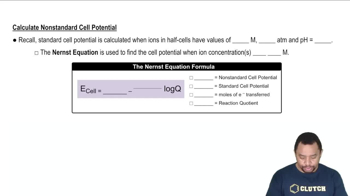
The Nernst equation relates the cell potential to the concentrations of the reactants and products in an electrochemical cell. It is expressed as E = E° - (RT/nF) ln(Q), where E is the cell potential, E° is the standard cell potential, R is the gas constant, T is the temperature in Kelvin, n is the number of moles of electrons transferred, F is Faraday's constant, and Q is the reaction quotient. This equation helps predict how changes in concentration affect the cell's voltage.
Video consigliato:
Percorso guidato
01:17
The Nernst Equation

Electrode Reactions

In a concentration cell, the electrode reactions involve the oxidation and reduction of the same species at different concentrations. At the anode, the species in lower concentration loses electrons (oxidation), while at the cathode, the species in higher concentration gains electrons (reduction). This transfer of electrons is what generates electrical energy, and the concentration of the ions in each half-cell will change as the cell operates, with the anode's concentration decreasing and the cathode's concentration increasing.
Video consigliato:
Percorso guidato
03:29
Electron Capture & Positron Emission Reaction Example