
A Cu/Cu2+ concentration cell has a voltage of 0.22 V at 25 °C. The concentration of Cu2+ in one of the half-cells is 1.5×10⁻³ M. What is the concentration of Cu2+ in the other half-cell? (Assume the concentration in the unknown cell is the lower of the two concentrations.)
Ch.20 - Electrochemistry
Tro5th EditionChemistry: A Molecular ApproachISBN: 9780134874371Non è quello che usi tu?Cambia libro di testo
Capitolo 20, Problema 83
Determine the optimum mass ratio of Zn to MnO2 in an alkaline battery.
Guida verificata passo dopo passo1
Identify the chemical reactions involved in the operation of an alkaline battery, focusing on the reactions of zinc (Zn) and manganese dioxide (MnO2).
Write the balanced chemical equations for the oxidation of Zn and the reduction of MnO2 in the battery.
Calculate the molar masses of Zn and MnO2 using the periodic table to understand how much each substance weighs per mole.
Use stoichiometry from the balanced equations to determine the mole ratio of Zn to MnO2 required for the reactions to proceed completely without any excess reactant.
Convert the mole ratio into a mass ratio by multiplying the mole ratio by the molar masses of Zn and MnO2, respectively. This will give you the optimum mass ratio of Zn to MnO2 for the battery.

Risposta video verificata per un problema simile:
Questa soluzione video è stata consigliata dai nostri tutor come utile per risolvere questo problema.
Durata del video:
10mConcetti chiave
Ecco i concetti essenziali che devi comprendere per rispondere correttamente alla domanda.
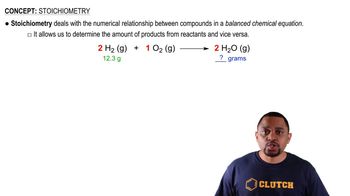
Stoichiometry
Stoichiometry is the calculation of reactants and products in chemical reactions. It involves using balanced chemical equations to determine the proportions of elements or compounds needed for a reaction. In the context of the Zn and MnO2 ratio, stoichiometry helps identify the optimal mass ratio based on their molar relationships in the battery's electrochemical reactions.
Video consigliato:
Percorso guidato
Stoichiometry Concept
Electrochemistry
Electrochemistry is the branch of chemistry that deals with the relationship between electrical energy and chemical changes. In alkaline batteries, the redox reactions between zinc and manganese dioxide generate electrical energy. Understanding the electrochemical processes is crucial for determining how the mass ratio affects the battery's efficiency and performance.
Video consigliato:
Percorso guidato
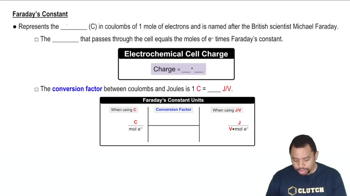
Faraday's Constant in Electrochemistry
Battery Chemistry
Battery chemistry refers to the study of the chemical reactions that occur within a battery to store and release energy. In alkaline batteries, zinc acts as the anode and MnO2 as the cathode. The optimum mass ratio of these materials is essential for maximizing energy output and ensuring the battery operates effectively over its lifespan.
Video consigliato:
Percorso guidato
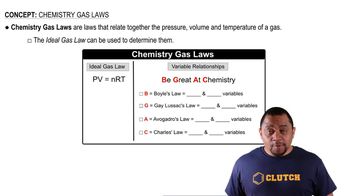
Chemistry Gas Laws
Pratica correlata
Domanda del libro di testo
3843
views
Domanda del libro di testo
Consider the concentration cell:
c. Indicate what happens to the concentration of Pb2+ in each half-cell.
598
views
Domanda del libro di testo
What mass of lead sulfate is formed in a lead–acid storage battery when 1.00 g of Pb undergoes oxidation?
493
views
Domanda del libro di testo
Refer to the tabulated values of ∆G°f in Appendix IIB to calculate E°cell for the fuel-cell breathalyzer, which employs the following reaction. ((∆G° for HC2H3O2(g) = -374.2 kJ/mol.)
CH3CH2OH(g) + O2(g) → HC2H3O2(g) + H2O(g)
544
views
Domanda del libro di testo
A concentration cell consists of two Sn/Sn2+ half-cells. The cell has a potential of 0.10 V at 25°C. What is the ratio of the Sn2+ concentrations in the two half-cells?
2408
views
2
rank
