Ch.5 - Introduction to Solutions and Aqueous Solutions
Tro - Chemistry: A Molecular Approach 5th Edition
Tro5th EditionChemistry: A Molecular ApproachISBN: 9780134874371Non è quello che usi tu?Cambia libro di testo
Capitolo 5, Problema 46

Write a molecular equation for the precipitation reaction that occurs (if any) when each pair of aqueous solutions is mixed. If no reaction occurs, write 'NO REACTION.' a. sodium chloride and lead(II) acetate b. potassium sulfate and strontium iodide c. cesium chloride and calcium sulfide d. chromium(III) nitrate and sodium phosphate

Guida verificata passo dopo passo
1
Identify the ions present in each solution when dissolved in water.
Determine the possible combinations of cations and anions that can form new compounds.
Use solubility rules to determine if any of the new combinations form an insoluble compound (precipitate).
Write the balanced molecular equation for the reaction, including states of matter (s for solid, aq for aqueous).
If no insoluble compound is formed, state 'NO REACTION.'

Risposta video verificata per un problema simile:

Questa soluzione video è stata consigliata dai nostri tutor come utile per risolvere questo problema.
Durata del video:
10m

Concetti chiave

Ecco i concetti essenziali che devi comprendere per rispondere correttamente alla domanda.

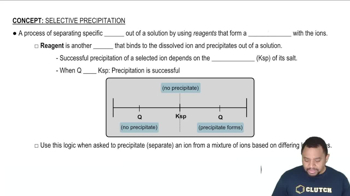
Precipitation Reactions

Precipitation reactions occur when two aqueous solutions react to form an insoluble solid, known as a precipitate. This process is driven by the formation of a compound that is not soluble in water, leading to the separation of the solid from the solution. Identifying potential precipitates involves consulting solubility rules, which dictate the solubility of various ionic compounds in water.
Video consigliato:
Percorso guidato
01:53
Selective Precipitation

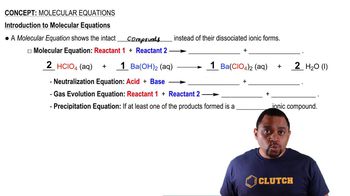
Molecular Equations

A molecular equation represents the reactants and products of a chemical reaction in their molecular forms, without showing the dissociation of ionic compounds in solution. This type of equation provides a clear picture of the substances involved and is useful for visualizing the overall reaction. In precipitation reactions, the molecular equation highlights the formation of the precipitate alongside any remaining soluble ions.
Video consigliato:
Percorso guidato
02:24
Types of Molecular Equations

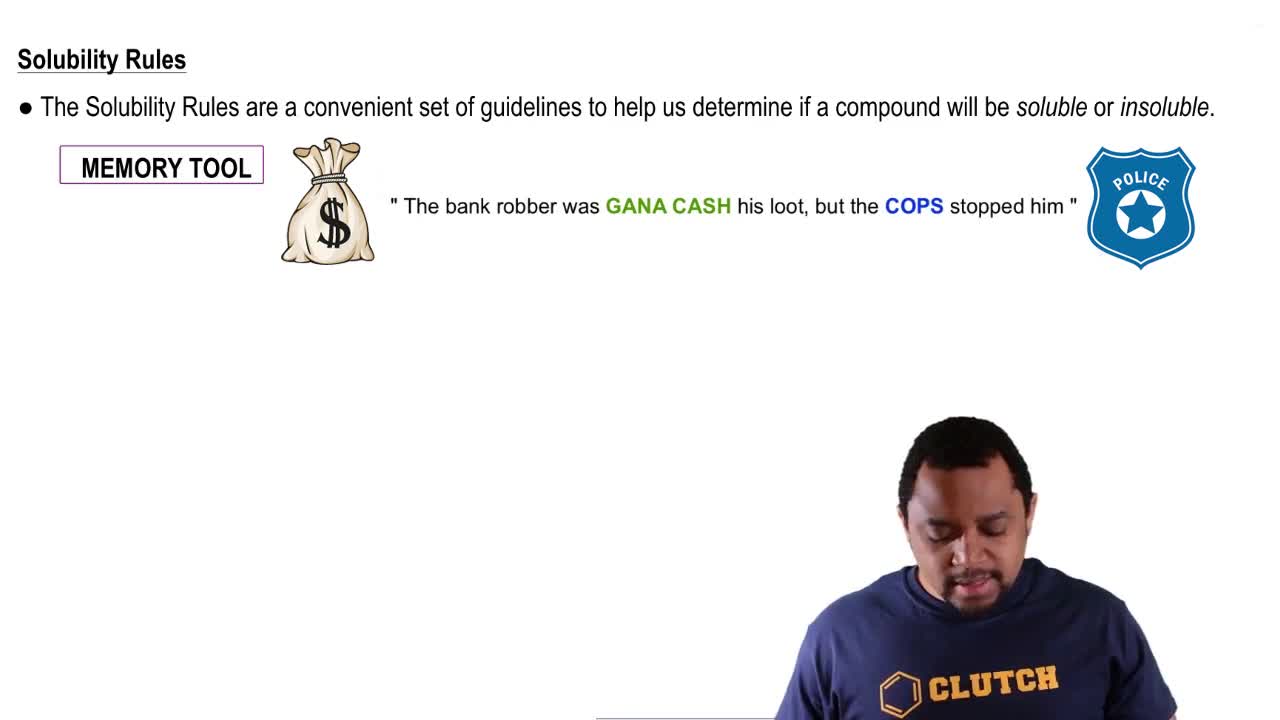
Solubility Rules

Solubility rules are guidelines that help predict whether a compound will dissolve in water or form a precipitate. These rules categorize ionic compounds based on their anions and cations, indicating which combinations are generally soluble or insoluble. Understanding these rules is essential for determining the outcome of mixing different ionic solutions and for writing accurate molecular equations for precipitation reactions.
Video consigliato:
Percorso guidato
00:28
Solubility Rules