Ch.5 - Introduction to Solutions and Aqueous Solutions
Tro - Chemistry: A Molecular Approach 5th Edition
Tro5th EditionChemistry: A Molecular ApproachISBN: 9780134874371Non è quello che usi tu?Cambia libro di testo
Capitolo 5, Problema 47b

Write balanced complete ionic and net ionic equations for each reaction.  CaS(aq) + CuCl2(aq) → CuS(s) + CaCl2(aq)

Guida verificata passo dopo passo
1
Identify the states of matter for each compound: CaS(aq), CuCl2(aq), CuS(s), and CaCl2(aq).
Write the balanced molecular equation: CaS(aq) + CuCl2(aq) → CuS(s) + CaCl2(aq).
Write the complete ionic equation by separating all aqueous compounds into their ions: Ca^{2+}(aq) + S^{2-}(aq) + Cu^{2+}(aq) + 2Cl^{-}(aq) → CuS(s) + Ca^{2+}(aq) + 2Cl^{-}(aq).
Identify and cancel the spectator ions that appear on both sides of the complete ionic equation: Ca^{2+}(aq) and 2Cl^{-}(aq).
Write the net ionic equation by including only the ions and compounds that participate in the reaction: Cu^{2+}(aq) + S^{2-}(aq) → CuS(s).

Risposta video verificata per un problema simile:

Questa soluzione video è stata consigliata dai nostri tutor come utile per risolvere questo problema.
Durata del video:
4m

Concetti chiave

Ecco i concetti essenziali che devi comprendere per rispondere correttamente alla domanda.

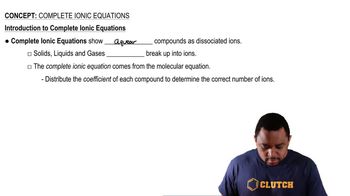
Complete Ionic Equation

A complete ionic equation represents all the ions present in a solution during a chemical reaction. It shows the reactants and products in their ionic forms, highlighting the dissociation of soluble ionic compounds. This equation is essential for understanding how ions interact in solution and sets the stage for identifying the net ionic equation.
Video consigliato:
Percorso guidato
00:47
Complete Ionic Equations

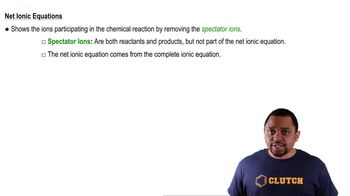
Net Ionic Equation

The net ionic equation simplifies the complete ionic equation by removing spectator ions—ions that do not participate in the actual chemical reaction. It focuses solely on the ions and molecules that undergo a change, providing a clearer picture of the chemical process. This equation is crucial for understanding the essence of the reaction and the formation of precipitates or other products.
Video consigliato:
Percorso guidato
00:51
Net Ionic Equations

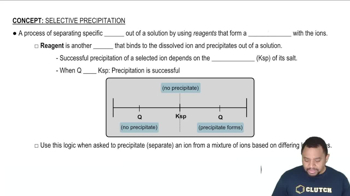
Precipitation Reaction

A precipitation reaction occurs when two aqueous solutions react to form an insoluble solid, known as a precipitate. This process is driven by the formation of a compound that cannot remain dissolved in the solution. Recognizing the conditions under which a precipitate forms is vital for predicting the products of a reaction and writing the corresponding ionic equations.
Video consigliato:
Percorso guidato
01:53
Selective Precipitation