Determine whether each transition in the hydrogen atom corresponds to absorption or emission of energy. a. n = 3 → n = 1 b. n = 2 → n = 4 c. n = 4 → n = 3
Ch.8 - The Quantum-Mechanical Model of the Atom
Tro5th EditionChemistry: A Molecular ApproachISBN: 9780134874371Non è quello che usi tu?Cambia libro di testo
Capitolo 8, Problema 68
According to the quantum-mechanical model for the hydrogen atom, which electron transition produces light with the longer wavelength: 3p → 2s or 4p → 3p?
Guida verificata passo dopo passo1
Understand that the wavelength of light emitted during an electron transition is inversely proportional to the energy difference between the two levels. This means that a smaller energy difference results in a longer wavelength.
Recall the formula for the energy difference between two levels in a hydrogen atom: \( \Delta E = -13.6 \left( \frac{1}{n_f^2} - \frac{1}{n_i^2} \right) \) eV, where \( n_i \) and \( n_f \) are the initial and final principal quantum numbers, respectively.
For the transition 3p \( \rightarrow \) 2s, identify the principal quantum numbers: \( n_i = 3 \) and \( n_f = 2 \).
For the transition 4p \( \rightarrow \) 3p, identify the principal quantum numbers: \( n_i = 4 \) and \( n_f = 3 \).
Compare the energy differences for both transitions using the formula, and determine which transition has the smaller energy difference, indicating the longer wavelength of emitted light.

Risposta video verificata per un problema simile:
Questa soluzione video è stata consigliata dai nostri tutor come utile per risolvere questo problema.
Durata del video:
3mConcetti chiave
Ecco i concetti essenziali che devi comprendere per rispondere correttamente alla domanda.
Electron Transitions
Electron transitions refer to the movement of electrons between different energy levels or orbitals in an atom. When an electron moves from a higher energy level to a lower one, it releases energy in the form of light. The energy of the emitted light corresponds to the difference in energy between the two levels, influencing the wavelength of the light produced.
Video consigliato:
Percorso guidato
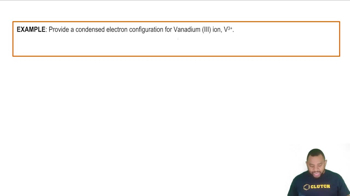
Electron Configurations Of Transition Metals Example
Wavelength and Energy Relationship
The wavelength of light is inversely related to its energy, as described by the equation E = hc/λ, where E is energy, h is Planck's constant, c is the speed of light, and λ is wavelength. This means that transitions resulting in lower energy emissions will produce longer wavelengths of light. Understanding this relationship is crucial for determining which electron transition produces light of a longer wavelength.
Video consigliato:
Percorso guidato
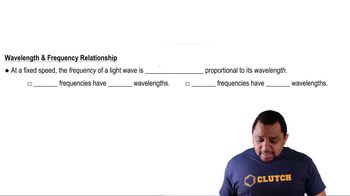
Frequency-Wavelength Relationship
Quantum Numbers and Energy Levels
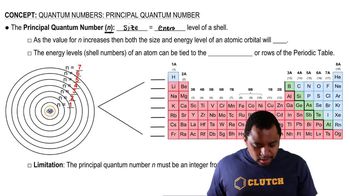
Quantum numbers describe the properties of atomic orbitals and the electrons in those orbitals. The principal quantum number (n) indicates the energy level, while the angular momentum quantum number (l) indicates the shape of the orbital. In the hydrogen atom, transitions between different principal quantum levels (like 2s to 3p or 3p to 4p) determine the energy and wavelength of the emitted light, with higher n values generally corresponding to higher energy levels.
Video consigliato:
Percorso guidato
Principal Quantum Number
Pratica correlata
Domanda del libro di testo
3571
views
3
rank
Domanda del libro di testo
An electron in the n = 7 level of the hydrogen atom relaxes to a lower-energy level, emitting light of 397 nm. What is the value of n for the level to which the electron relaxed?
8549
views
5
rank
2
comments
Domanda del libro di testo
Calculate the frequency of the light emitted when an electron in a hydrogen atom makes each transition: a. n = 4 → n = 3 b. n = 5 → n = 1 c. n = 5 → n = 4 d. n = 6 → n = 5
8404
views
1
rank
Domanda del libro di testo
Calculate the wavelength of the light emitted when an electron in a hydrogen atom makes each transition and indicate the region of the electromagnetic spectrum (infrared, visible, ultraviolet, etc.) where the light is found. a. n = 2 → n = 1 b. n = 3 → n = 1 c. n = 4 → n = 2 d. n = 5 → n = 2
2102
views