Ch.9 - Periodic Properties of the Elements
Tro - Chemistry: A Molecular Approach 5th Edition
Tro5th EditionChemistry: A Molecular ApproachISBN: 9780134874371Non è quello che usi tu?Cambia libro di testo
Capitolo 9, Problema 69

Arrange this isoelectronic series in order of decreasing radius: O2-, F-, Na+, Mg2+.

Guida verificata passo dopo passo
1
Identify that isoelectronic species have the same number of electrons. In this case, each species has 10 electrons.
Recognize that the size of isoelectronic species is influenced by the nuclear charge (number of protons). The more protons, the stronger the attraction to the electrons, and the smaller the radius.
List the atomic numbers (number of protons) for each species: O (8), F (9), Na (11), Mg (12).
Arrange the species in order of increasing nuclear charge: O^{2-} (8 protons), F^{-} (9 protons), Na^{+} (11 protons), Mg^{2+} (12 protons).
Order the species by decreasing radius, which is the reverse of increasing nuclear charge: O^{2-}, F^{-}, Na^{+}, Mg^{2+}.

Concetti chiave

Ecco i concetti essenziali che devi comprendere per rispondere correttamente alla domanda.

Isoelectronic Species

Isoelectronic species are atoms or ions that have the same number of electrons. In this case, O2-, F-, Na+, and Mg2+ all have 10 electrons, making them isoelectronic. Understanding this concept is crucial because it allows us to compare their sizes based on their nuclear charge and electron-electron repulsion.
Video consigliato:
Percorso guidato
03:03
Amphoteric Species

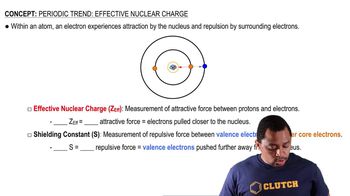
Effective Nuclear Charge (Z_eff)

Effective nuclear charge refers to the net positive charge experienced by an electron in a multi-electron atom. It accounts for the shielding effect of inner electrons. In the isoelectronic series, as the nuclear charge increases from O2- to Mg2+, the effective nuclear charge increases, pulling the electrons closer to the nucleus and resulting in a smaller atomic radius.
Video consigliato:
Percorso guidato
01:51
Effective Nuclear Charge

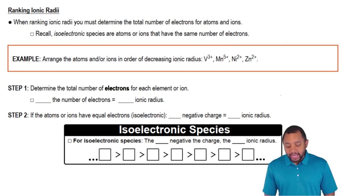
Trends in Ionic Radii

Ionic radii trends indicate that cations are generally smaller than their parent atoms due to the loss of electrons and increased effective nuclear charge, while anions are larger due to the addition of electrons and increased electron-electron repulsion. In the given series, the order of decreasing radius is influenced by the charge of the ions, with O2- being the largest and Mg2+ the smallest.
Video consigliato:
Percorso guidato
03:56
Ranking Ionic Radii