Ch.9 - Periodic Properties of the Elements
Tro - Chemistry: A Molecular Approach 5th Edition
Tro5th EditionChemistry: A Molecular ApproachISBN: 9780134874371Non è quello che usi tu?Cambia libro di testo
Capitolo 9, Problema 68

Which is the larger species in each pair? a. Sr or Sr2+ b. N or N3- c. Ni or Ni2+ d. S2- or Ca2+

Guida verificata passo dopo passo
1
1. The size of an atom or ion is determined by the number of electron shells it has and the effective nuclear charge. The effective nuclear charge is the net positive charge experienced by an electron in a multi-electron atom. The more protons in the nucleus, the stronger the pull on the electrons and the smaller the atom or ion.
2. For Sr and Sr2+, Sr2+ has lost two electrons compared to Sr. This means it has a higher effective nuclear charge and fewer electron shells, making it smaller.
3. For N and N3-, N3- has gained three electrons compared to N. This means it has a lower effective nuclear charge and more electron shells, making it larger.
4. For Ni and Ni2+, Ni2+ has lost two electrons compared to Ni. This means it has a higher effective nuclear charge and fewer electron shells, making it smaller.
5. For S2- and Ca2+, S2- has gained two electrons compared to Ca2+ which has lost two electrons. This means S2- has a lower effective nuclear charge and more electron shells, making it larger.

Risposta video verificata per un problema simile:

Questa soluzione video è stata consigliata dai nostri tutor come utile per risolvere questo problema.
Durata del video:
5m

Concetti chiave

Ecco i concetti essenziali che devi comprendere per rispondere correttamente alla domanda.

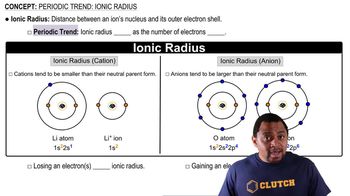
Ionic Radius

Ionic radius refers to the size of an ion in a crystal lattice. Cations, which are positively charged ions, are generally smaller than their neutral atoms due to the loss of electrons, leading to increased effective nuclear charge on the remaining electrons. Conversely, anions, which are negatively charged ions, are larger than their neutral atoms because the addition of electrons increases electron-electron repulsion, causing the electron cloud to expand.
Video consigliato:

Charge and Size Relationship

The charge of an ion significantly affects its size. When an atom loses electrons to form a cation, it becomes smaller due to the reduced electron-electron repulsion and increased attraction between the nucleus and the remaining electrons. In contrast, when an atom gains electrons to form an anion, it becomes larger because the added electrons increase repulsion among them, leading to a larger ionic size.
Video consigliato:

Comparative Analysis of Ions

To determine which species is larger in a pair of ions, one must compare their ionic charges and the corresponding neutral atoms. Generally, for a given element, the neutral atom is larger than its cation, while the anion is larger than the neutral atom. Thus, when comparing pairs like Sr and Sr²⁺ or N and N³⁻, the neutral species will typically be the larger one, while the anion will be larger than the neutral atom.
Video consigliato:
Percorso guidato
06:11
Dimensional Analysis