Ch.9 - Periodic Properties of the Elements
Tro - Chemistry: A Molecular Approach 5th Edition
Tro5th EditionChemistry: A Molecular ApproachISBN: 9780134874371Non è quello che usi tu?Cambia libro di testo
Capitolo 9, Problema 83

Bromine is a highly reactive liquid while krypton is an inert gas. Explain this difference based on their electron configurations.

Guida verificata passo dopo passo
1
Identify the electron configuration of bromine: Bromine (Br) has an atomic number of 35. Its electron configuration is [Ar] 3d^10 4s^2 4p^5.
Identify the electron configuration of krypton: Krypton (Kr) has an atomic number of 36. Its electron configuration is [Ar] 3d^10 4s^2 4p^6.
Explain the reactivity of bromine: Bromine has 7 electrons in its outermost p orbital (4p^5), which means it needs one more electron to achieve a stable, full octet configuration. This makes bromine highly reactive as it tends to gain an electron to achieve stability.
Explain the inertness of krypton: Krypton has a complete outer shell with 8 electrons in its outermost p orbital (4p^6), achieving a stable noble gas configuration. This full octet makes krypton chemically inert, as it does not need to gain or lose electrons.
Conclude the difference: The difference in reactivity between bromine and krypton is due to their electron configurations. Bromine is reactive because it seeks to complete its octet, while krypton is inert because it already has a complete octet.

Concetti chiave

Ecco i concetti essenziali che devi comprendere per rispondere correttamente alla domanda.

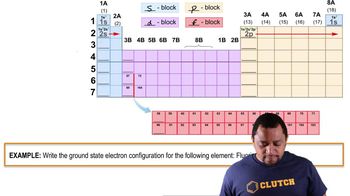
Electron Configuration

Electron configuration describes the distribution of electrons in an atom's orbitals. It is represented using a notation that indicates the energy levels and sublevels occupied by electrons. Understanding electron configuration is crucial for predicting an element's chemical behavior, as it determines how an atom interacts with others.
Video consigliato:
Percorso guidato
01:33
Electron Configuration Example

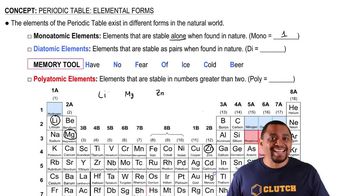
Reactivity of Elements

The reactivity of elements is largely influenced by their electron configurations, particularly the presence of unpaired electrons in the outermost shell. Elements with incomplete outer shells, like bromine, tend to be more reactive as they seek to achieve stability by gaining, losing, or sharing electrons. In contrast, elements with full outer shells, like krypton, are generally inert and do not readily participate in chemical reactions.
Video consigliato:
Percorso guidato
02:35
Elemental Forms of Elements

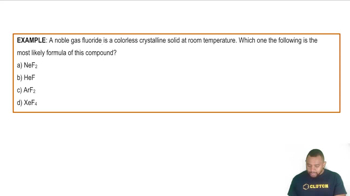
Noble Gases vs. Halogens

Noble gases, such as krypton, have complete valence electron shells, making them stable and unreactive. In contrast, halogens like bromine have seven valence electrons and require only one more to achieve a full shell, which makes them highly reactive. This fundamental difference in electron configuration explains the contrasting chemical behaviors of these two groups of elements.
Video consigliato:
Percorso guidato
00:44
Noble Gas Compounds Example