Ch.9 - Periodic Properties of the Elements
Tro - Chemistry: A Molecular Approach 5th Edition
Tro5th EditionChemistry: A Molecular ApproachISBN: 9780134874371Non è quello che usi tu?Cambia libro di testo
Capitolo 9, Problema 22

Which of the transition elements in the first transition series have anomalous electron configurations?

Guida verificata passo dopo passo
1
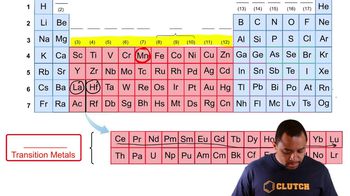
Understand that transition elements are those found in the d-block of the periodic table, specifically groups 3 to 12.
The first transition series includes elements from Scandium (Sc) to Zinc (Zn), with atomic numbers 21 to 30.
Recall that electron configurations are typically written by filling the lowest energy orbitals first, following the Aufbau principle, Hund's rule, and the Pauli exclusion principle.
Identify that anomalous electron configurations occur when electrons fill or half-fill d orbitals to achieve a more stable configuration, often seen in Chromium (Cr) and Copper (Cu) in the first transition series.
For Chromium, instead of the expected [Ar] 3d^4 4s^2, the configuration is [Ar] 3d^5 4s^1. For Copper, instead of [Ar] 3d^9 4s^2, the configuration is [Ar] 3d^10 4s^1. This is due to the extra stability associated with half-filled and fully filled d subshells.

Risposta video verificata per un problema simile:

Questa soluzione video è stata consigliata dai nostri tutor come utile per risolvere questo problema.
Durata del video:
4m

Concetti chiave

Ecco i concetti essenziali che devi comprendere per rispondere correttamente alla domanda.

Transition Elements

Transition elements, or transition metals, are the d-block elements in the periodic table, characterized by their ability to form variable oxidation states and colored compounds. They include elements such as iron, copper, and nickel, which have partially filled d-orbitals. Understanding their electron configurations is crucial for predicting their chemical behavior and properties.
Video consigliato:
Percorso guidato
03:30
Transition Metals and Representative Elements

Electron Configuration

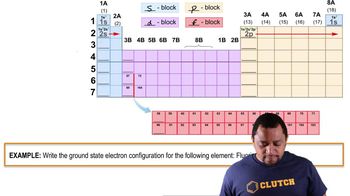
Electron configuration describes the distribution of electrons in an atom's orbitals. For transition metals, this involves filling the 3d and 4s orbitals. Anomalous electron configurations occur when electrons are promoted from the s-orbital to the d-orbital to achieve greater stability, often seen in elements like chromium and copper.
Video consigliato:
Percorso guidato
01:33
Electron Configuration Example

Anomalous Electron Configurations

Anomalous electron configurations refer to deviations from the expected order of electron filling in atoms. In transition metals, this often results in a more stable arrangement by having half-filled or fully filled d-orbitals. For example, chromium (Cr) has an electron configuration of [Ar] 3d5 4s1 instead of the expected [Ar] 3d4 4s2, highlighting the importance of stability in electron arrangements.
Video consigliato:
Percorso guidato
01:33
Electron Configuration Example