Ch.9 - Periodic Properties of the Elements
Tro - Chemistry: A Molecular Approach 5th Edition
Tro5th EditionChemistry: A Molecular ApproachISBN: 9780134874371Non è quello che usi tu?Cambia libro di testo
Capitolo 9, Problema 39

Write the full electron configuration for each element. a. Si b. O c. K d. Ne

Guida verificata passo dopo passo
1
Identify the atomic number of each element to determine the number of electrons: Si (14), O (8), K (19), Ne (10).
Recall the order of electron filling according to the Aufbau principle: 1s, 2s, 2p, 3s, 3p, 4s, 3d, 4p, etc.
For Si (Silicon), distribute 14 electrons: Fill 1s, 2s, 2p, 3s, and then 3p orbitals.
For O (Oxygen), distribute 8 electrons: Fill 1s, 2s, and then 2p orbitals.
For K (Potassium), distribute 19 electrons: Fill 1s, 2s, 2p, 3s, 3p, and then 4s orbitals. For Ne (Neon), distribute 10 electrons: Fill 1s, 2s, and then 2p orbitals.

Risposta video verificata per un problema simile:

Questa soluzione video è stata consigliata dai nostri tutor come utile per risolvere questo problema.
Durata del video:
4m

Concetti chiave

Ecco i concetti essenziali che devi comprendere per rispondere correttamente alla domanda.

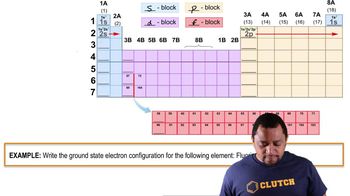
Electron Configuration

Electron configuration describes the distribution of electrons in an atom's orbitals. It follows the Aufbau principle, which states that electrons fill the lowest energy orbitals first, and is represented using a notation that includes the principal quantum number and the type of orbital (s, p, d, f). For example, the electron configuration of oxygen (O) is 1s² 2s² 2p⁴.
Video consigliato:
Percorso guidato
01:33
Electron Configuration Example

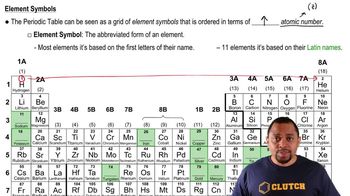
Periodic Table and Atomic Number

The periodic table organizes elements based on their atomic number, which is the number of protons in an atom's nucleus. This number determines the element's identity and influences its electron configuration. For instance, silicon (Si) has an atomic number of 14, indicating it has 14 electrons that fill its orbitals according to the rules of electron configuration.
Video consigliato:
Percorso guidato
04:01
Periodic Table History

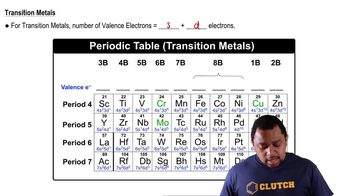
Valence Electrons

Valence electrons are the outermost electrons of an atom and are crucial for determining chemical reactivity and bonding behavior. The number of valence electrons can be inferred from the electron configuration, particularly from the highest principal energy level. For example, potassium (K) has one valence electron in its 4s orbital, which makes it highly reactive.
Video consigliato:
Percorso guidato
02:12
Transition Metals Valence Electrons