Domanda del libro di testo
Use molecular orbital theory to predict if each molecule or ion exists in a relatively stable form. a. F22–

 Tro 6th EditionCh.11 - Chemical Bonding II: Molecular Shapes, VSEPR & MO TheoryProblema 81
 Guida verificata passo dopo passo
 03:06
03:06
 00:36
00:36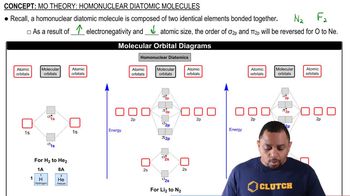 03:10
03:10Use molecular orbital theory to predict if each molecule or ion exists in a relatively stable form. a. F22–
According to MO theory, which molecule or ion has the highest bond energy? O2, O2- , O22-
Using the molecular orbital energy ordering for second-row homonuclear diatomic molecules in which the π2p orbitals lie at higher energy than the σ2p, draw MO energy diagrams and predict the bond order in a molecule or ion with each number of total valence electrons. Will the molecule or ion be diamagnetic or paramagnetic? c. 13
Using the molecular orbital energy ordering for second-row homonuclear diatomic molecules in which the π2p orbitals lie at higher energy than the σ2p, draw MO energy diagrams and predict the bond order in a molecule or ion with each number of total valence electrons. Will the molecule or ion be diamagnetic or paramagnetic? a. 10
Using the molecular orbital energy ordering for second-row homonuclear diatomic molecules in which the π2p orbitals lie at higher energy than the σ2p, draw MO energy diagrams and predict the bond order in a molecule or ion with each number of total valence electrons. Will the molecule or ion be diamagnetic or paramagnetic? d. 14
According to MO theory, which molecule or ion has the highest bond order? O2, O2- , O22-