Ch.11 - Chemical Bonding II: Molecular Shapes, VSEPR & MO Theory
Tro - Chemistry: A Molecular Approach 6th Edition
Tro6th EditionChemistry: A Molecular ApproachISBN: 9780137832217Non è quello che usi tu?Cambia libro di testo
Capitolo 11, Problema 82a

Use molecular orbital theory to predict if each molecule or ion exists in a relatively stable form. a. F22–

Guida verificata passo dopo passo
1
Identify the total number of electrons in the molecule or ion. For F2^{2-}, each fluorine atom has 9 electrons, and the 2- charge adds 2 more electrons, giving a total of 20 electrons.
Write the electron configuration for the molecule using molecular orbitals. For diatomic molecules like F2^{2-}, use the order: \( \sigma_{1s}^2, \sigma^*_{1s}^2, \sigma_{2s}^2, \sigma^*_{2s}^2, \sigma_{2p_z}^2, \pi_{2p_x}^2, \pi_{2p_y}^2, \pi^*_{2p_x}^2, \pi^*_{2p_y}^2, \sigma^*_{2p_z}^2 \).
Fill the molecular orbitals with the 20 electrons according to the Aufbau principle, Pauli exclusion principle, and Hund's rule.
Calculate the bond order using the formula: \( \text{Bond Order} = \frac{(\text{Number of bonding electrons} - \text{Number of antibonding electrons})}{2} \).
Determine the stability of the molecule. A positive bond order indicates a stable molecule, while a bond order of zero or negative suggests instability.

Risposta video verificata per un problema simile:

Questa soluzione video è stata consigliata dai nostri tutor come utile per risolvere questo problema.
Durata del video:
8m

Concetti chiave

Ecco i concetti essenziali che devi comprendere per rispondere correttamente alla domanda.

Molecular Orbital Theory

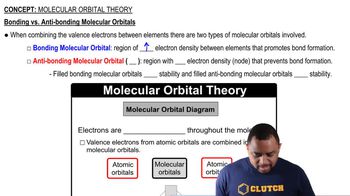
Molecular Orbital Theory (MOT) describes the behavior of electrons in molecules by combining atomic orbitals to form molecular orbitals. These orbitals can be bonding, antibonding, or non-bonding, and the distribution of electrons among them determines the stability and properties of the molecule. Understanding MOT is essential for predicting molecular stability and reactivity.
Video consigliato:
Percorso guidato
03:06
Molecular Orbital Theory

Bond Order

Bond order is a measure of the number of chemical bonds between a pair of atoms, calculated as the difference between the number of bonding and antibonding electrons divided by two. A higher bond order indicates a more stable molecule, while a bond order of zero suggests that the molecule is unstable and unlikely to exist. This concept is crucial for assessing the stability of the F22– ion.
Video consigliato:
Percorso guidato
00:36
Average Bond Order

Electron Configuration in Ions

The electron configuration of ions reflects the distribution of electrons in molecular orbitals after accounting for the gain or loss of electrons. For the F22– ion, two additional electrons must be considered, which will occupy the available molecular orbitals. Analyzing the resulting electron configuration helps determine the overall stability and existence of the ion.
Video consigliato:
Percorso guidato
00:35
Anion Electron Configuration