Ch.12 - Liquids, Solids & Intermolecular Forces
Tro - Chemistry: A Molecular Approach 6th Edition
Tro6th EditionChemistry: A Molecular ApproachISBN: 9780137832217Non è quello che usi tu?Cambia libro di testo
Capitolo 12, Problema 46b

In each pair of compounds, pick the one with the higher boiling point. Explain your reasoning. b. CH3OH or CH3SH

Guida verificata passo dopo passo
1
Identify the functional groups present in each compound: CH_3OH has a hydroxyl group (-OH), and CH_3SH has a thiol group (-SH).
Consider the type of intermolecular forces present in each compound: CH_3OH can form hydrogen bonds due to the presence of the -OH group, while CH_3SH can only form weaker dipole-dipole interactions and London dispersion forces.
Recall that hydrogen bonding is a stronger intermolecular force compared to dipole-dipole interactions and London dispersion forces, leading to higher boiling points.
Compare the strength of the intermolecular forces: CH_3OH, with hydrogen bonding, will have stronger intermolecular forces than CH_3SH, which lacks hydrogen bonding.
Conclude that CH_3OH will have a higher boiling point than CH_3SH due to the presence of hydrogen bonding.

Risposta video verificata per un problema simile:

Questa soluzione video è stata consigliata dai nostri tutor come utile per risolvere questo problema.
Durata del video:
1m

Concetti chiave

Ecco i concetti essenziali che devi comprendere per rispondere correttamente alla domanda.

Hydrogen Bonding

Hydrogen bonding is a strong type of dipole-dipole interaction that occurs when hydrogen is bonded to highly electronegative atoms like oxygen or nitrogen. In the case of CH3OH (methanol), the presence of an -OH group allows for hydrogen bonding, significantly increasing its boiling point compared to compounds that cannot form such interactions.
Video consigliato:
Percorso guidato
01:22
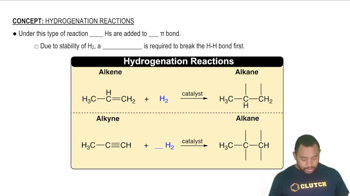
Hydrogenation Reactions

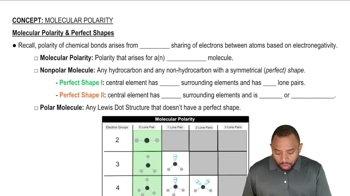
Molecular Polarity

Molecular polarity refers to the distribution of electrical charge over the atoms in a molecule. Polar molecules, like CH3OH, have regions of partial positive and negative charge, which leads to stronger intermolecular forces. In contrast, CH3SH (methanethiol) is less polar, resulting in weaker van der Waals forces and a lower boiling point.
Video consigliato:
Percorso guidato
02:38
Molecular Polarity

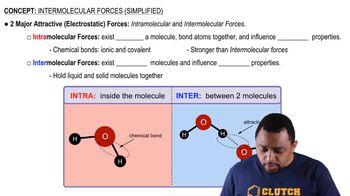
Intermolecular Forces

Intermolecular forces are the forces of attraction or repulsion between neighboring particles (atoms, molecules, or ions). The strength of these forces directly affects the boiling point of a substance; stronger intermolecular forces, such as hydrogen bonds in CH3OH, lead to higher boiling points compared to weaker forces in CH3SH.
Video consigliato:
Percorso guidato
01:59
Intermolecular vs Intramolecular Forces