Ch.12 - Liquids, Solids & Intermolecular Forces
Tro - Chemistry: A Molecular Approach 6th Edition
Tro6th EditionChemistry: A Molecular ApproachISBN: 9780137832217Non è quello che usi tu?Cambia libro di testo
Capitolo 12, Problema 48a,c

In each pair of compounds, pick the one with the higher vapor pressure at a given temperature. Explain your reasoning. a. CH4 or CH3Cl c. CH3OH or H2CO

Guida verificata passo dopo passo
1
Identify the intermolecular forces present in each compound. CH_3OH (methanol) has hydrogen bonding due to the presence of an -OH group, while H_2CO (formaldehyde) has dipole-dipole interactions and London dispersion forces.
Recall that stronger intermolecular forces result in lower vapor pressure because more energy is required to overcome these forces and allow molecules to escape into the vapor phase.
Compare the strength of the intermolecular forces: hydrogen bonding in CH_3OH is stronger than the dipole-dipole interactions in H_2CO.
Conclude that the compound with weaker intermolecular forces will have a higher vapor pressure at a given temperature.
Based on the comparison, determine that H_2CO, with weaker dipole-dipole interactions, will have a higher vapor pressure than CH_3OH, which has stronger hydrogen bonding.

Risposta video verificata per un problema simile:

Questa soluzione video è stata consigliata dai nostri tutor come utile per risolvere questo problema.
Durata del video:
4m

Concetti chiave

Ecco i concetti essenziali che devi comprendere per rispondere correttamente alla domanda.

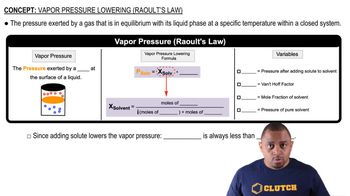
Vapor Pressure

Vapor pressure is the pressure exerted by a vapor in equilibrium with its liquid or solid phase at a given temperature. It reflects the tendency of molecules to escape from the liquid or solid state into the gas phase. Compounds with higher vapor pressures at a specific temperature typically have weaker intermolecular forces, allowing more molecules to enter the vapor phase.
Video consigliato:
Percorso guidato
02:40
Raoult's Law and Vapor Pressure

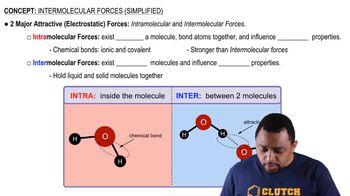
Intermolecular Forces

Intermolecular forces are the forces of attraction or repulsion between neighboring particles (atoms, molecules, or ions). These forces include hydrogen bonding, dipole-dipole interactions, and London dispersion forces. Stronger intermolecular forces result in lower vapor pressures, as more energy is required for molecules to escape into the vapor phase.
Video consigliato:
Percorso guidato
01:59
Intermolecular vs Intramolecular Forces

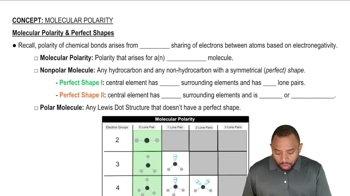
Molecular Structure and Polarity

The molecular structure and polarity of a compound significantly influence its physical properties, including vapor pressure. Polar molecules, like CH3OH (methanol), can form hydrogen bonds, which are strong intermolecular forces. In contrast, H2CO (formaldehyde) is less polar and has weaker dipole interactions, leading to a higher vapor pressure compared to methanol at the same temperature.
Video consigliato:
Percorso guidato
02:38
Molecular Polarity