Ch.13 - Solids & Modern Materials
Tro - Chemistry: A Molecular Approach 6th Edition
Tro6th EditionChemistry: A Molecular ApproachISBN: 9780137832217Non è quello che usi tu?Cambia libro di testo
Capitolo 13, Problema 44b

Identify each solid as molecular, ionic, or atomic. b. H2O(s)

Guida verificata passo dopo passo
1
Identify the type of bonding present in the solid. Water (H2O) is composed of non-metal atoms bonded together, which typically indicates covalent bonding.
Consider the structure of the solid. In the case of water, the solid form is ice, where molecules are held together by hydrogen bonds.
Determine the type of solid based on the bonding and structure. Molecular solids are composed of molecules held together by intermolecular forces, such as hydrogen bonds, dipole-dipole interactions, or London dispersion forces.
Recognize that H2O(s) is a molecular solid because it consists of discrete H2O molecules held together by hydrogen bonds.
Conclude that the solid H2O(s) is a molecular solid due to the presence of covalently bonded molecules and intermolecular hydrogen bonding.

Risposta video verificata per un problema simile:

Questa soluzione video è stata consigliata dai nostri tutor come utile per risolvere questo problema.
Durata del video:
1m

Concetti chiave

Ecco i concetti essenziali che devi comprendere per rispondere correttamente alla domanda.

Molecular Solids

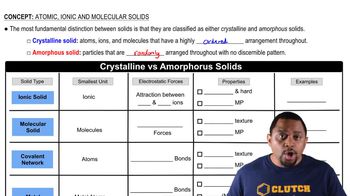
Molecular solids are composed of molecules held together by intermolecular forces such as hydrogen bonds, dipole-dipole interactions, or London dispersion forces. These solids typically have lower melting and boiling points compared to ionic or atomic solids. An example is ice (solid H2O), where water molecules are arranged in a crystalline structure due to hydrogen bonding.
Video consigliato:
Percorso guidato
04:13
Crystalline vs Amorphous Solids

Ionic Solids

Ionic solids consist of positively and negatively charged ions held together by strong electrostatic forces known as ionic bonds. These solids generally have high melting and boiling points due to the strength of the ionic interactions. Common examples include sodium chloride (NaCl) and magnesium oxide (MgO), which form a lattice structure.
Video consigliato:
Percorso guidato
00:34
Ionic Solid Identification Example

Atomic Solids

Atomic solids are composed of atoms held together by covalent bonds, metallic bonds, or van der Waals forces. They can be further classified into covalent network solids, like diamond, which have very high melting points, and metallic solids, which conduct electricity and have variable melting points. Atomic solids are characterized by their strong bonding and structural integrity.
Video consigliato:
Percorso guidato
04:13
Crystalline vs Amorphous Solids