Ch.15 - Chemical Kinetics
Tro - Chemistry: A Molecular Approach 6th Edition
Tro6th EditionChemistry: A Molecular ApproachISBN: 9780137832217Non è quello che usi tu?Cambia libro di testo
Capitolo 15, Problema 69

The rate constant (k) for a reaction was measured as a function of temperature. A plot of ln k versus 1/T (in K) is linear and has a slope of -7012 K. Calculate the activation energy for the reaction.

Guida verificata passo dopo passo
1
Identify the relationship between the slope of the plot and the activation energy using the Arrhenius equation: \( \ln k = \ln A - \frac{E_a}{R} \cdot \frac{1}{T} \).
Recognize that the slope of the plot \( \ln k \) versus \( \frac{1}{T} \) is equal to \( -\frac{E_a}{R} \), where \( E_a \) is the activation energy and \( R \) is the universal gas constant.
Use the given slope of the plot, which is -7012 K, and set it equal to \( -\frac{E_a}{R} \).
Solve for the activation energy \( E_a \) by rearranging the equation: \( E_a = -\text{slope} \times R \).
Substitute the value of the universal gas constant \( R = 8.314 \text{ J/mol K} \) into the equation to find \( E_a \).

Risposta video verificata per un problema simile:

Questa soluzione video è stata consigliata dai nostri tutor come utile per risolvere questo problema.

Concetti chiave

Ecco i concetti essenziali che devi comprendere per rispondere correttamente alla domanda.

Arrhenius Equation

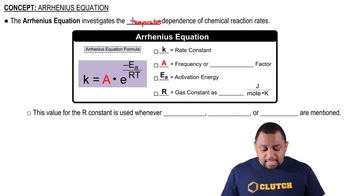
The Arrhenius equation describes how the rate constant (k) of a chemical reaction depends on temperature (T) and activation energy (Ea). It is expressed as k = A * e^(-Ea/RT), where A is the pre-exponential factor, R is the universal gas constant, and T is the temperature in Kelvin. This relationship indicates that as temperature increases, the rate constant typically increases, reflecting a higher likelihood of overcoming the activation energy barrier.
Video consigliato:
Percorso guidato
01:20
Arrhenius Equation

Activation Energy (Ea)

Activation energy is the minimum energy required for a chemical reaction to occur. It represents the energy barrier that reactants must overcome to transform into products. A higher activation energy means that fewer molecules have sufficient energy to react at a given temperature, resulting in a slower reaction rate. The activation energy can be determined from the slope of a plot of ln k versus 1/T, as it is directly related to the slope in the Arrhenius equation.
Video consigliato:
Percorso guidato
02:02
Activity Series Chart

Linear Regression in Kinetics

In chemical kinetics, linear regression is often used to analyze the relationship between the natural logarithm of the rate constant (ln k) and the inverse of temperature (1/T). A linear plot indicates a consistent relationship, allowing for the determination of activation energy from the slope. The slope of the line in this context is equal to -Ea/R, where R is the gas constant, enabling the calculation of activation energy when the slope is known.
Video consigliato:
Percorso guidato
00:34
Kinetic & Potential Energy