Ch.15 - Chemical Kinetics
Tro - Chemistry: A Molecular Approach 6th Edition
Tro6th EditionChemistry: A Molecular ApproachISBN: 9780137832217Non è quello che usi tu?Cambia libro di testo
Capitolo 15, Problema 67

The activation energy of a reaction is 44.2 kJ/mol and the frequency factor is 1.9⨉1011/ s. Calculate the rate constant of the reaction at 25 °C.

Guida verificata passo dopo passo
1
Convert the temperature from Celsius to Kelvin by adding 273.15 to the given temperature in Celsius.
Use the Arrhenius equation: k = A * e^(-Ea/(R*T)), where k is the rate constant, A is the frequency factor, Ea is the activation energy, R is the gas constant (8.314 J/mol*K), and T is the temperature in Kelvin.
Convert the activation energy from kJ/mol to J/mol by multiplying by 1000.
Substitute the values for A, Ea, R, and T into the Arrhenius equation.
Calculate the exponent and then the rate constant k using the Arrhenius equation.

Risposta video verificata per un problema simile:

Questa soluzione video è stata consigliata dai nostri tutor come utile per risolvere questo problema.
Durata del video:
1m

Concetti chiave

Ecco i concetti essenziali che devi comprendere per rispondere correttamente alla domanda.

Activation Energy

Activation energy is the minimum energy required for a chemical reaction to occur. It represents the energy barrier that reactants must overcome to transform into products. In the context of the Arrhenius equation, a higher activation energy typically results in a slower reaction rate, as fewer molecules have sufficient energy to react at a given temperature.
Video consigliato:
Percorso guidato
02:02
Activity Series Chart

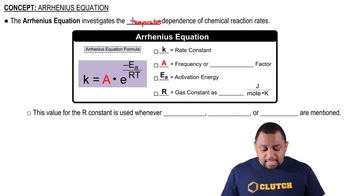
Arrhenius Equation

The Arrhenius equation relates the rate constant of a reaction to its activation energy and temperature. It is expressed as k = A * e^(-Ea/RT), where k is the rate constant, A is the frequency factor, Ea is the activation energy, R is the universal gas constant, and T is the temperature in Kelvin. This equation allows for the calculation of the rate constant based on the energy dynamics of the reaction.
Video consigliato:
Percorso guidato
01:20
Arrhenius Equation

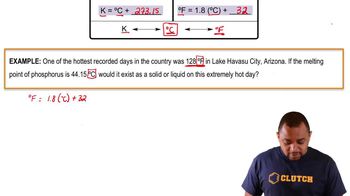
Temperature Conversion

In chemical calculations, temperatures must often be converted to Kelvin, as the Kelvin scale is the standard for thermodynamic equations. To convert Celsius to Kelvin, one adds 273.15 to the Celsius temperature. For example, 25 °C is equivalent to 298.15 K. Accurate temperature conversion is crucial for correctly applying the Arrhenius equation and determining the rate constant.
Video consigliato:
Percorso guidato
02:10
Temperature Conversion Example
Pratica correlata
Domanda del libro di testo

The rate constant (k) for a reaction was measured as a function of temperature. A plot of ln k versus 1/T (in K) is linear and has a slope of -7012 K. Calculate the activation energy for the reaction.

Domanda del libro di testo

The diagram shows the energy of a reaction as the reaction progresses. Label each blank box in the diagram.

a. reactants b. products c. activation energy (Ea) d. enthalpy of reaction (ΔHrxn)

2043
views
Domanda del libro di testo

The half-life for the radioactive decay of C-14 is 5715 years and is independent of the initial concentration. If a sample of C-14 initially contains 1.5 mmol of C-14, how many millimoles are left after 2725 years?

Domanda del libro di testo

The data shown here were collected for the first-order reaction: N2O(g) → N2(g) + O(g) Use an Arrhenius plot to determine the activation barrier and frequency factor for the reaction.

Temperature (K) Rate Constant (1 , s)

800 3.24⨉10- 5

900 0.00214

1000 0.0614

1100 0.955

1575
views
Domanda del libro di testo

The half-life for the radioactive decay of C-14 is 5715 years and is independent of the initial concentration. How long does it take for 25.00% of the C-14 atoms in a sample of C-14 to decay?

Domanda del libro di testo

The tabulated data show the rate constant of a reaction measured at several different temperatures. Use an Arrhenius plot to determine the activation barrier and frequency factor for the reaction.

Temperature (K) Rate Constant (1 , s)

300 0.0134

310 0.0407

320 0.114

330 0.303

340 0.757

2534
views