
Ch.15 - Chemical Kinetics
Tro - Chemistry: A Molecular Approach 6th Edition
Tro6th EditionChemistry: A Molecular ApproachISBN: 9780137832217Non è quello che usi tu?Cambia libro di testo
Capitolo 15, Problema 35a(i)

Consider the reaction: H2(g) + Br2(g) → 2 HBr(g) The graph shows the concentration of Br2 as a function of time.
a. Use the graph to calculate each quantity: (i) the average rate of the reaction between 0 and 25 s

Guida verificata passo dopo passo
1
Identify the concentration of Br2 at time t = 0 s and at t = 25 s from the graph. These values will be your initial concentration \( [\mathrm{Br}_2]_0 \) and final concentration \( [\mathrm{Br}_2]_{25} \), respectively.
Calculate the change in concentration of Br2 over the time interval from 0 to 25 seconds using the formula: \( \Delta [\mathrm{Br}_2] = [\mathrm{Br}_2]_{25} - [\mathrm{Br}_2]_0 \).
Determine the time interval \( \Delta t \) which is 25 seconds in this case.
Calculate the average rate of disappearance of Br2 using the formula for average rate: \( \text{Average rate} = -\frac{\Delta [\mathrm{Br}_2]}{\Delta t} \). The negative sign accounts for the fact that the concentration of Br2 decreases over time.
Express the average rate with appropriate units (usually mol/L·s) and interpret it as the rate of the reaction over the 0 to 25 seconds interval.

Risposta video verificata per un problema simile:

Questa soluzione video è stata consigliata dai nostri tutor come utile per risolvere questo problema.
Durata del video:
5m

Concetti chiave

Ecco i concetti essenziali che devi comprendere per rispondere correttamente alla domanda.

Reaction Rate

Reaction rate measures how fast reactants are consumed or products are formed over time. It is often expressed as the change in concentration of a substance per unit time, such as mol/L·s. Understanding reaction rate helps quantify how quickly a chemical reaction proceeds.
Video consigliato:
Percorso guidato
02:03
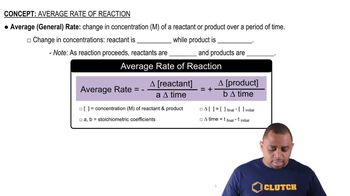
Average Rate of Reaction

Average Rate of Reaction

The average rate of reaction over a time interval is calculated by dividing the change in concentration of a reactant or product by the elapsed time. For reactants, the rate is negative since their concentration decreases, while for products it is positive. This provides an overall rate between two points in time.
Video consigliato:
Percorso guidato
02:03
Average Rate of Reaction

Interpreting Concentration vs. Time Graphs

A concentration vs. time graph shows how the concentration of a species changes during a reaction. The slope of the graph between two points represents the rate of change of concentration. Calculating the slope between 0 and 25 seconds gives the average rate of consumption or formation of that species.
Video consigliato:
Percorso guidato
03:12
Precipitation: Ksp vs Q Example