Ch.15 - Chemical Kinetics
Tro - Chemistry: A Molecular Approach 6th Edition
Tro6th EditionChemistry: A Molecular ApproachISBN: 9780137832217Non è quello che usi tu?Cambia libro di testo
Capitolo 15, Problema 27b

Consider the reaction:
2 HBr (g) → H2 (g) + Br2 (g)
b. In the first 20.0 s of this reaction, the concentration of HBr dropped from 0.600 M to 0.512 M. Calculate the average rate of the reaction during this time interval.

Guida verificata passo dopo passo
1
Identify the change in concentration of HBr over the given time period. The initial concentration \([HBr]_i\) is 0.600 M and the final concentration \([HBr]_f\) is 0.512 M.
Calculate the change in concentration of HBr, \(\Delta [HBr]\), using the formula: \(\Delta [HBr] = [HBr]_f - [HBr]_i\).
Determine the time interval \(\Delta t\) over which the reaction occurs, which is given as 20.0 seconds.
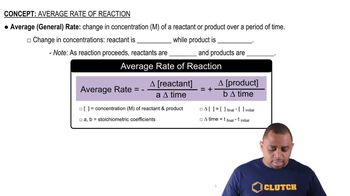
Use the formula for the average rate of reaction: \(\text{Average rate} = -\frac{\Delta [HBr]}{\Delta t}\). The negative sign indicates the concentration of HBr is decreasing.
Substitute the values of \(\Delta [HBr]\) and \(\Delta t\) into the average rate formula to find the average rate of the reaction.

Risposta video verificata per un problema simile:

Questa soluzione video è stata consigliata dai nostri tutor come utile per risolvere questo problema.
Durata del video:
1m

Concetti chiave

Ecco i concetti essenziali che devi comprendere per rispondere correttamente alla domanda.

Average Rate of Reaction

The average rate of a chemical reaction is defined as the change in concentration of a reactant or product over a specific time interval. It is calculated using the formula: average rate = Δ[concentration] / Δ[time]. This concept is crucial for understanding how quickly a reaction occurs and is typically expressed in units of molarity per second (M/s).
Video consigliato:
Percorso guidato
02:03
Average Rate of Reaction

Concentration

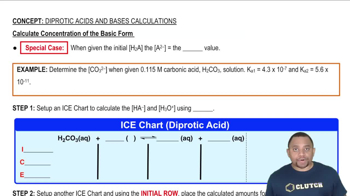
Concentration refers to the amount of a substance (solute) present in a given volume of solution. It is commonly expressed in molarity (M), which is moles of solute per liter of solution. Understanding concentration is essential for calculating reaction rates, as changes in concentration directly influence the speed of the reaction.
Video consigliato:
Percorso guidato
07:35
Calculate Concentration of the Basic Form

Stoichiometry

Stoichiometry is the study of the quantitative relationships between the reactants and products in a chemical reaction. It is based on the balanced chemical equation, which indicates the proportions in which substances react and are produced. This concept is important for understanding how changes in the concentration of one reactant affect the concentrations of others during the reaction.
Video consigliato:
Percorso guidato
01:16
Stoichiometry Concept