Which of these two reactions would you expect to have the smaller orientation factor? Explain. a. O(g) + N2(g) → NO( g) + N(g) b. NO(g) + Cl2(g) → NOCl( g) + Cl(g)
Ch.15 - Chemical Kinetics

Tro6th EditionChemistry: A Molecular ApproachISBN: 9780137832217Non è quello che usi tu?Cambia libro di testo
Capitolo 15, Problema 81
Consider this overall reaction, which is experimentally observed to be second order in AB and zero order in C: AB + C → A + BC Is the following mechanism valid for this reaction? AB + AB →k1 AB2 + A Slow AB2 + C → k2 AB + BC Fast
Guida verificata passo dopo passo1
Identify the overall reaction: AB + C \(\rightarrow\) A + BC.
Determine the rate law from the given information: The reaction is second order in AB and zero order in C, so the rate law is rate = k[AB]^2.
Examine the proposed mechanism: Step 1: AB + AB \(\xrightarrow{k_1}\) AB_2 + A (Slow), Step 2: AB_2 + C \(\xrightarrow{k_2}\) AB + BC (Fast).
Identify the rate-determining step: The slow step (Step 1) is the rate-determining step, so the rate law should be based on this step.
Check if the rate law from the mechanism matches the experimental rate law: The rate of the slow step is rate = k_1[AB]^2, which matches the experimental rate law, confirming the mechanism is valid.

Risposta video verificata per un problema simile:
Questa soluzione video è stata consigliata dai nostri tutor come utile per risolvere questo problema.
Durata del video:
1mConcetti chiave
Ecco i concetti essenziali che devi comprendere per rispondere correttamente alla domanda.
Reaction Order
Reaction order refers to the power to which the concentration of a reactant is raised in the rate law of a chemical reaction. In this case, the reaction is second order in AB, meaning that the rate of reaction is proportional to the square of the concentration of AB. Understanding reaction order is crucial for analyzing how changes in concentration affect the rate of the reaction.
Video consigliato:
Percorso guidato
Average Bond Order
Rate Law
The rate law expresses the relationship between the rate of a chemical reaction and the concentration of its reactants. For the given reaction, the rate law can be written as rate = k[AB]^2[C]^0, indicating that the rate depends only on the concentration of AB. This concept is essential for determining whether a proposed mechanism is consistent with the observed reaction order.
Video consigliato:
Percorso guidato
Rate Law Fundamentals
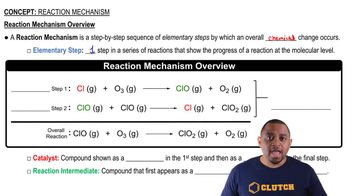
Elementary Steps in Reaction Mechanisms
Elementary steps are the individual steps that make up a reaction mechanism, each representing a single molecular event. The validity of a proposed mechanism can be assessed by ensuring that the slowest step (rate-determining step) aligns with the overall reaction order. In this case, the first step is slow and should reflect the second-order dependence on AB, while the second step must not affect the overall order with respect to C.
Video consigliato:
Percorso guidato
Reaction Mechanism Overview
Pratica correlata
Domanda del libro di testo
1178
views
Domanda del libro di testo
Consider this three-step mechanism for a reaction:
Cl2 (g) k1⇌k2 2 Cl (g) Fast
Cl (g) + CHCl3 (g) →k3 HCl (g) + CCl3 (g) Slow
Cl (g) + CCl3 (g) →k4 CCl4 (g) Fast
a. What is the overall reaction?
625
views
Domanda del libro di testo
Consider these two gas-phase reactions: a. AA(g) + BB(g) → 2 AB(g) b. AB(g) + CD(g) → AC(g) + BD(g) If the reactions have identical activation barriers and are carried out under the same conditions, which one would you expect to have the faster rate?
1584
views
Domanda del libro di testo
Consider this three-step mechanism for a reaction:
Cl2 (g) k1⇌k2 2 Cl (g) Fast
Cl (g) + CHCl3 (g) →k3 HCl (g) + CCl3 (g) Slow
Cl (g) + CCl3 (g) →k4 CCl4 (g) Fast
c. What is the predicted rate law?
3695
views