Ch.15 - Chemical Kinetics
Tro - Chemistry: A Molecular Approach 6th Edition
Tro6th EditionChemistry: A Molecular ApproachISBN: 9780137832217Non è quello che usi tu?Cambia libro di testo
Capitolo 15, Problema 80

Which of these two reactions would you expect to have the smaller orientation factor? Explain. a. O(g) + N2(g) → NO( g) + N(g) b. NO(g) + Cl2(g) → NOCl( g) + Cl(g)

Guida verificata passo dopo passo
1
Identify the complexity of the molecular structures involved in each reaction. Simpler molecules with fewer atoms generally have a higher orientation factor because there are fewer ways they can align to react.
Consider the symmetry of the reactant molecules. Molecules with higher symmetry might have a higher orientation factor as they can effectively react in multiple orientations.
Analyze the reaction mechanism if known. Reactions involving complex mechanisms or multiple steps might have a smaller orientation factor due to the specificity of the alignment needed for the reaction to proceed.
Evaluate the size of the molecules. Larger molecules might have a smaller orientation factor because the correct alignment of reactive sites is statistically less likely.
Compare the two reactions based on these criteria to determine which one likely has the smaller orientation factor. Reaction a involves simpler and smaller molecules (O(g) and N2(g)) compared to reaction b which involves slightly larger and more complex molecules (NO(g) and Cl2(g)).

Risposta video verificata per un problema simile:

Questa soluzione video è stata consigliata dai nostri tutor come utile per risolvere questo problema.
Durata del video:
2m

Concetti chiave

Ecco i concetti essenziali che devi comprendere per rispondere correttamente alla domanda.

Orientation Factor

The orientation factor, often denoted as 'p', is a term in the collision theory of chemical reactions that accounts for the likelihood of reactant molecules colliding in the correct orientation to form products. It reflects how the spatial arrangement of molecules affects the probability of successful collisions leading to a reaction. A smaller orientation factor indicates that the reactants are less likely to collide in a favorable orientation.
Video consigliato:
Percorso guidato
01:29
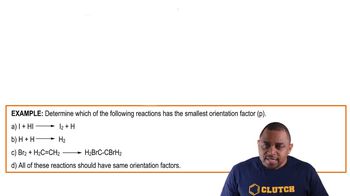
Orientation Factor Example

Reaction Mechanism

A reaction mechanism is a step-by-step description of the pathway taken by reactants to form products. It includes the sequence of elementary steps, intermediates, and transition states involved in the reaction. Understanding the mechanism helps in predicting the orientation factor, as more complex mechanisms may involve more specific orientations for successful collisions.
Video consigliato:
Percorso guidato
03:06
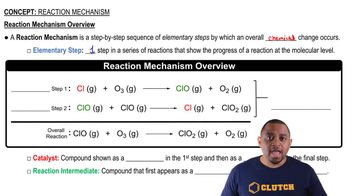
Reaction Mechanism Overview

Steric Hindrance

Steric hindrance refers to the repulsion between atoms that occurs when they are brought close together, often due to the size of the atoms or groups attached to them. In chemical reactions, steric hindrance can affect the orientation factor by making it more difficult for reactants to align properly for a successful reaction. Reactions with bulky groups or complex structures typically exhibit higher steric hindrance, leading to a smaller orientation factor.