The tabulated data were collected for this reaction at 500 °C: CH3CN(g) → CH3NC( g) a. Determine the order of the reaction and the value of the rate constant at this temperature.
Ch.15 - Chemical Kinetics

Tro6th EditionChemistry: A Molecular ApproachISBN: 9780137832217Non è quello che usi tu?Cambia libro di testo
Capitolo 15, Problema 89b
The tabulated data were collected for this reaction at 500 °C: CH3CN(g) → CH3NC( g) b. What is the half-life for this reaction (at the initial concentration)?
Guida verificata passo dopo passo1
Identify the order of the reaction by analyzing the concentration vs. time data.
Use the appropriate integrated rate law for the determined order to find the half-life expression.
For a first-order reaction, the half-life is given by \( t_{1/2} = \frac{0.693}{k} \), where \( k \) is the rate constant.
Determine the rate constant \( k \) using the slope of the plot of \( \ln [A] \) vs. time for a first-order reaction.
Substitute the value of \( k \) into the half-life expression to find the half-life at the initial concentration.

Risposta video verificata per un problema simile:
Questa soluzione video è stata consigliata dai nostri tutor come utile per risolvere questo problema.
Durata del video:
5mConcetti chiave
Ecco i concetti essenziali che devi comprendere per rispondere correttamente alla domanda.
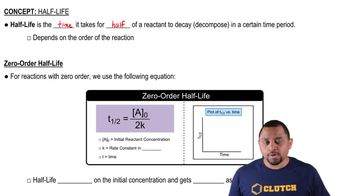
Half-life
Half-life is the time required for the concentration of a reactant to decrease to half of its initial value. It is a crucial concept in kinetics, particularly for first-order reactions, where the half-life is constant and independent of concentration. Understanding half-life allows chemists to predict how long it will take for a reaction to reach a certain point, which is essential for analyzing reaction rates.
Video consigliato:
Percorso guidato
Zero-Order Half-life
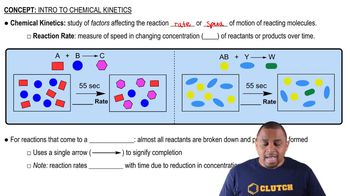
Reaction Kinetics
Reaction kinetics is the study of the rates of chemical reactions and the factors that affect these rates. It involves understanding how concentration, temperature, and catalysts influence the speed of a reaction. In this context, knowing the kinetics of the reaction between CH3CN and CH3NC is necessary to calculate the half-life and understand the reaction's behavior over time.
Video consigliato:
Percorso guidato
Chemical Kinetics
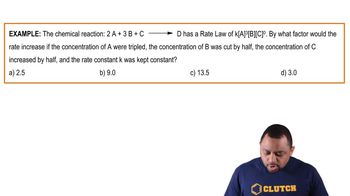
Concentration and Rate Laws
Concentration refers to the amount of a substance in a given volume, which directly impacts the rate of a chemical reaction. Rate laws express the relationship between the rate of a reaction and the concentration of its reactants. For the given reaction, determining the initial concentration of CH3CN is essential for calculating the half-life, as it influences how quickly the reaction proceeds.
Video consigliato:
Percorso guidato
Concentration Changes and Rate Law Example
Pratica correlata
Domanda del libro di testo
1711
views
Domanda del libro di testo
The activation barrier for the hydrolysis of sucrose into glucose and fructose is 108 kJ/mol. If an enzyme increases the rate of the hydrolysis reaction by a factor of 1 million, how much lower must the activation barrier be when sucrose is in the active site of the enzyme? (Assume that the frequency factors for the catalyzed and uncatalyzed reactions are identical and a temperature of 25 °C.)
1809
views
Domanda del libro di testo
The tabulated data were collected for this reaction at a certain temperature: X2Y → 2 X + Y c. What is the concentration of X after 10.0 hours?
1122
views
Domanda del libro di testo
The tabulated data were collected for this reaction at a certain temperature: X2Y → 2 X + Y a. Determine the order of the reaction and the value of the rate constant at this temperature.
756
views