The tabulated data were collected for this reaction at 500 °C: CH3CN(g) → CH3NC( g) a. Determine the order of the reaction and the value of the rate constant at this temperature.
Ch.15 - Chemical Kinetics

Tro6th EditionChemistry: A Molecular ApproachISBN: 9780137832217Non è quello che usi tu?Cambia libro di testo
Capitolo 15, Problema 90c
The tabulated data were collected for this reaction at a certain temperature: X2Y → 2 X + Y c. What is the concentration of X after 10.0 hours?
Guida verificata passo dopo passo1
Determine the rate law for the reaction. This involves understanding how the concentration of reactants affects the rate of the reaction.
Use the integrated rate law that corresponds to the order of the reaction. For example, if it's a first-order reaction, use the first-order integrated rate law: \( [A] = [A]_0 e^{-kt} \).
Identify the initial concentration of X, \([X]_0\), from the data provided.
Calculate the rate constant \(k\) using the data provided and the appropriate rate law.
Substitute the values of \([X]_0\), \(k\), and \(t = 10.0\) hours into the integrated rate law to find the concentration of X after 10.0 hours.

Risposta video verificata per un problema simile:
Questa soluzione video è stata consigliata dai nostri tutor come utile per risolvere questo problema.
Durata del video:
8mConcetti chiave
Ecco i concetti essenziali che devi comprendere per rispondere correttamente alla domanda.
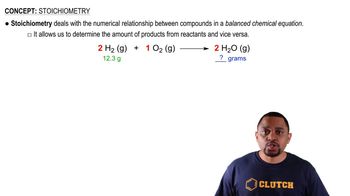
Chemical Reaction Stoichiometry
Stoichiometry involves the calculation of reactants and products in chemical reactions based on balanced equations. In the given reaction, X<sub>2</sub>Y decomposes into 2 moles of X and 1 mole of Y, indicating the molar relationships between the substances. Understanding these ratios is essential for determining the concentration of products formed over time.
Video consigliato:
Percorso guidato
Stoichiometry Concept
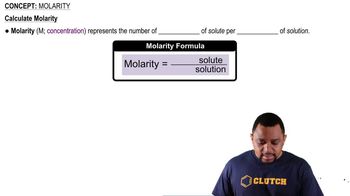
Concentration and Molarity
Concentration refers to the amount of a substance in a given volume of solution, commonly expressed in molarity (moles per liter). To find the concentration of X after a specified time, one must consider the initial concentration of reactants and how they change as the reaction proceeds. This concept is crucial for quantifying the amount of X produced after 10.0 hours.
Video consigliato:
Percorso guidato
Molarity Concept
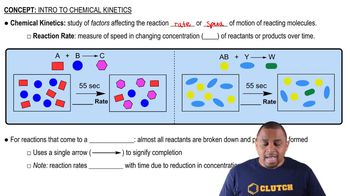
Reaction Kinetics
Reaction kinetics studies the rates of chemical reactions and the factors affecting them. The time factor in the question (10.0 hours) is significant, as it influences how much of the reactants have converted into products. Understanding the kinetics of the reaction helps predict the concentration of X at a specific time point.
Video consigliato:
Percorso guidato
Chemical Kinetics
Pratica correlata
Domanda del libro di testo
1711
views
Domanda del libro di testo
Consider the reaction: 2 O3(g) → 3 O2( g) The rate law for this reaction is: Rate = k [O3]2 [O2] Suppose that a 1.0-L reaction vessel initially contains 1.0 mol of O3 and 1.0 mol of O2. What fraction of the O3 will have reacted when the rate falls to one-half of its initial value?
2049
views
Domanda del libro di testo
The tabulated data were collected for this reaction at 500 °C: CH3CN(g) → CH3NC( g) b. What is the half-life for this reaction (at the initial concentration)?
477
views
Domanda del libro di testo
The tabulated data were collected for this reaction at a certain temperature: X2Y → 2 X + Y a. Determine the order of the reaction and the value of the rate constant at this temperature.
756
views