
Ch.15 - Chemical Kinetics
Tro - Chemistry: A Molecular Approach 6th Edition
Tro6th EditionChemistry: A Molecular ApproachISBN: 9780137832217Non è quello che usi tu?Cambia libro di testo
Capitolo 15, Problema 50

The tabulated data were collected for this reaction: CH3Cl(g) + 3 Cl2(g) → CCl4( g) + 3 HCl(g)
Table showing concentrations of reactants and initial reaction rates for chemical kinetics.
Write an expression for the reaction rate law and calculate the value of the rate constant, k. What is the overall order of the reaction?

Guida verificata passo dopo passo
1
Identify the general form of the rate law for the reaction: rate = k[A]^m[B]^n.
Use the data from the table to set up ratios of the rates and concentrations to determine the reaction orders m and n.
Compare experiments 1 and 2 where [B] is constant to find the order with respect to [A].
Compare experiments 1 and 3 where [A] is constant to find the order with respect to [B].
Once the orders m and n are determined, use any set of data from the table to solve for the rate constant k.

Risposta video verificata per un problema simile:

Questa soluzione video è stata consigliata dai nostri tutor come utile per risolvere questo problema.
Durata del video:
5m

Concetti chiave

Ecco i concetti essenziali che devi comprendere per rispondere correttamente alla domanda.

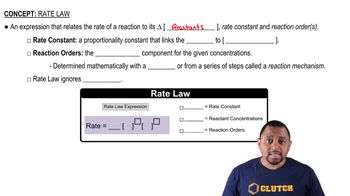
Rate Law

The rate law expresses the relationship between the rate of a chemical reaction and the concentration of its reactants. It is typically formulated as rate = k[A]^m[B]^n, where k is the rate constant, [A] and [B] are the concentrations of the reactants, and m and n are the reaction orders with respect to each reactant. Determining the rate law involves analyzing experimental data to find the values of m and n.
Video consigliato:
Percorso guidato
01:52
Rate Law Fundamentals

Order of Reaction

The order of a reaction is the sum of the exponents in the rate law expression. It indicates how the rate of reaction is affected by the concentration of the reactants. A reaction can be zero, first, second, or higher order, depending on the values of m and n. Understanding the order helps predict how changes in concentration will influence the reaction rate.
Video consigliato:
Percorso guidato
00:36
Average Bond Order

Rate Constant (k)

The rate constant, k, is a proportionality factor in the rate law that is specific to a particular reaction at a given temperature. It reflects the speed of the reaction and is influenced by factors such as temperature and the presence of catalysts. To calculate k, one can rearrange the rate law using known concentrations and initial rates from experimental data.
Video consigliato:
Percorso guidato
01:14
Equilibrium Constant K
Pratica correlata
Domanda del libro di testo

The tabulated data show the concentration of AB versus time for this reaction: AB( g)¡A( g) + B( g) Time (s) [AB] (M) 0 0.950 50 0.459 100 0.302 150 0.225 200 0.180 250 0.149 300 0.128 350 0.112 400 0.0994 450 0.0894 500 0.0812 Determine the order of the reaction and the value of the rate constant. Predict the concentration of AB at 25 s.

3257
views
4
comments
Domanda del libro di testo

Indicate the order of reaction consistent with each observation.

a. The half-life of the reaction gets shorter as the initial concentration is increased.

b. A plot of the natural log of the concentration of the reactant versus time yields a straight line.

970
views
Domanda del libro di testo

A reaction in which A, B, and C react to form products is zero order in A, one-half order in B, and second order in C. c. By what factor does the reaction rate change if [A] is doubled (and the other reactant concentrations are held constant)? d. By what factor does the reaction rate change if [B] is doubled? e. By what factor does the reaction rate change if [C] is doubled? f. By what factor does the reaction rate change if [C] is doubled (and the other reactant concentrations are held constant)?

2570
views
Domanda del libro di testo

Indicate the order of reaction consistent with each observation c. The half-life of the reaction gets longer as the initial concentration is increased.

404
views
Domanda del libro di testo

Consider the tabulated data showing the initial rate of a reaction (A → products) at several different concentrations of A. What is the order of the reaction? Write a rate law for the reaction including the value of the rate constant, k.

[A] (M) Initial Rate (M/s)

0.050 0.100

0.075 0.225

0.090 0.324

1
views