
Ch.16 - Chemical Equilibrium
Tro - Chemistry: A Molecular Approach 6th Edition
Tro6th EditionChemistry: A Molecular ApproachISBN: 9780137832217Non è quello che usi tu?Cambia libro di testo
Capitolo 16, Problema 57

Consider the reaction: NiO(s) + CO(g) ⇌ Ni(s) + CO2(g) Kc = 4.0 * 10^3 at 1500 K. If a mixture of solid nickel(II) oxide and 0.20 M carbon monoxide comes to equilibrium at 1500 K, what is the equilibrium concentration of CO2?

Guida verificata passo dopo passo
1
Identify the balanced chemical equation: NiO(s) + CO(g) ⇌ Ni(s) + CO2(g).
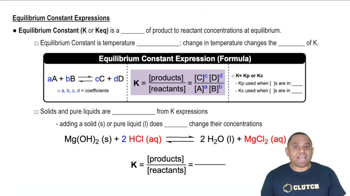
Recognize that solids do not appear in the equilibrium expression, so the equilibrium constant expression is K_c = [CO_2]/[CO].
Substitute the given equilibrium constant K_c = 4.0 \(\times\) 10^3 into the expression: 4.0 \(\times\) 10^3 = [CO_2]/[CO].
Let the change in concentration of CO be x, so at equilibrium, [CO] = 0.20 - x and [CO_2] = x.
Substitute these expressions into the equilibrium constant expression: 4.0 \(\times\) 10^3 = x/(0.20 - x) and solve for x, which represents the equilibrium concentration of CO_2.

Concetti chiave

Ecco i concetti essenziali che devi comprendere per rispondere correttamente alla domanda.

Equilibrium Constant (Kc)

The equilibrium constant, Kc, quantifies the ratio of the concentrations of products to reactants at equilibrium for a given reaction at a specific temperature. For the reaction provided, Kc = [CO2]/[CO], indicating that at equilibrium, the concentration of CO2 is significantly influenced by the concentration of CO and the value of Kc.
Video consigliato:
Percorso guidato
03:20
Equilibrium Constant Expressions

Le Chatelier's Principle

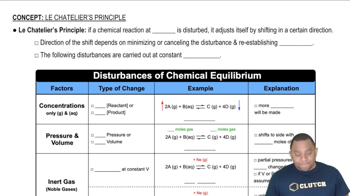
Le Chatelier's Principle states that if a system at equilibrium is disturbed, the system will adjust to counteract the disturbance and restore a new equilibrium. In this reaction, adding CO or changing the temperature could shift the equilibrium position, affecting the concentration of CO2 produced.
Video consigliato:
Percorso guidato
07:32
Le Chatelier's Principle

Stoichiometry of the Reaction

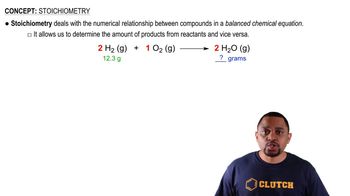
Stoichiometry involves the quantitative relationships between reactants and products in a chemical reaction. In this case, the balanced equation indicates that one mole of CO reacts with one mole of NiO to produce one mole of CO2, which is essential for calculating the equilibrium concentrations based on the initial concentrations and the changes at equilibrium.
Video consigliato:
Percorso guidato
01:16
Stoichiometry Concept