Ch.17 - Acids and Bases
Tro - Chemistry: A Molecular Approach 6th Edition
Tro6th EditionChemistry: A Molecular ApproachISBN: 9780137832217Non è quello che usi tu?Cambia libro di testo
Capitolo 17, Problema 67

Determine the [H3O+] and pH of a 0.200 M solution of benzoic acid.

Guida verificata passo dopo passo
1
Identify the chemical formula for benzoic acid, which is C6H5COOH, and recognize that it is a weak acid.
Write the equilibrium expression for the dissociation of benzoic acid in water: C6H5COOH + H2O \(\rightleftharpoons\) C6H5COO^- + H3O^+.
Use the acid dissociation constant (Ka) for benzoic acid, which is typically provided in a table, to set up the expression: Ka = \(\frac{[C6H5COO^-][H3O^+]}{[C6H5COOH]}\).
Assume that the initial concentration of benzoic acid is 0.200 M and that the change in concentration of H3O^+ and C6H5COO^- is x, leading to the expression: Ka = \(\frac{x^2}{0.200 - x}\).
Solve for x, which represents [H3O^+], and then calculate the pH using the formula: pH = -\(\log\)[H3O^+].

Risposta video verificata per un problema simile:

Questa soluzione video è stata consigliata dai nostri tutor come utile per risolvere questo problema.
Durata del video:
3m

Concetti chiave

Ecco i concetti essenziali che devi comprendere per rispondere correttamente alla domanda.

Acid-Base Equilibrium

Acid-base equilibrium refers to the balance between the concentrations of acids and their conjugate bases in a solution. In the case of weak acids like benzoic acid, this equilibrium is established when the acid partially dissociates in water, producing hydronium ions (H3O+) and its conjugate base. Understanding this concept is crucial for calculating the concentration of H3O+ in the solution.
Video consigliato:
Percorso guidato
6:47
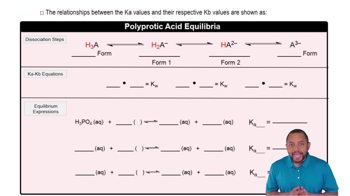
Triprotic Acid Equilibrium

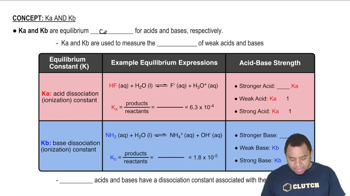
Dissociation Constant (Ka)

The dissociation constant (Ka) is a quantitative measure of the strength of an acid in solution. It represents the equilibrium constant for the dissociation of the acid into its ions. For benzoic acid, knowing its Ka value allows us to set up an equilibrium expression to find the concentration of H3O+ ions, which is essential for determining the pH of the solution.
Video consigliato:
Percorso guidato
03:50
Characteristics of Ka and Kb

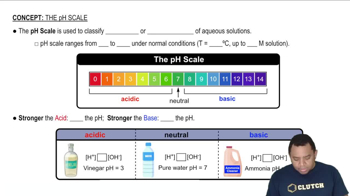
pH Scale

The pH scale is a logarithmic scale used to measure the acidity or basicity of a solution, defined as the negative logarithm of the hydronium ion concentration: pH = -log[H3O+]. A lower pH indicates a more acidic solution, while a higher pH indicates a more basic one. Calculating the pH from the concentration of H3O+ is a fundamental step in understanding the properties of the solution.
Video consigliato: