Ch.17 - Acids and Bases
Tro - Chemistry: A Molecular Approach 6th Edition
Tro6th EditionChemistry: A Molecular ApproachISBN: 9780137832217Non è quello che usi tu?Cambia libro di testo
Capitolo 17, Problema 70

Determine the pH of an HF solution of each concentration. In which cases can you not make the simplifying assumption that x is small? (Ka for HF is 6.8×10⁻⁴.) a. 0.250 M b. 0.0500 M c. 0.0250 M

Guida verificata passo dopo passo
1
1. The first step is to write the ionization equation for HF. HF is a weak acid, so it partially ionizes in water to form H+ and F-. The equation is: HF ⇌ H+ + F-.
2. Next, set up the ICE (Initial, Change, Equilibrium) table. For a 0.250 M HF solution, the initial concentrations are [HF] = 0.250 M, [H+] = 0 and [F-] = 0. The change in concentration is -x for HF and +x for H+ and F-. At equilibrium, the concentrations are [HF] = 0.250 - x, [H+] = x and [F-] = x.
3. The third step is to write the expression for the acid dissociation constant (Ka) and substitute the equilibrium concentrations from the ICE table. Ka = [H+][F-] / [HF] = (x)(x) / (0.250 - x) = 6.8 * 10^-4.
4. Solve the equation for x, which represents the concentration of H+ ions. If x is less than 5% of the initial concentration of HF, then the simplifying assumption that x is small is valid. If x is greater than 5% of the initial concentration, then the assumption is not valid and you would need to use the quadratic formula to solve for x.
5. Once you have the concentration of H+ ions, you can calculate the pH of the solution using the formula pH = -log[H+]. Repeat these steps for the other concentrations of HF.

Risposta video verificata per un problema simile:

Questa soluzione video è stata consigliata dai nostri tutor come utile per risolvere questo problema.
Durata del video:
7m

Concetti chiave

Ecco i concetti essenziali che devi comprendere per rispondere correttamente alla domanda.

Acid-Base Equilibrium

Acid-base equilibrium involves the balance between an acid and its conjugate base in solution. For weak acids like hydrofluoric acid (HF), this equilibrium can be described by the dissociation constant (Ka), which quantifies the extent to which the acid donates protons (H+) to the solution. Understanding this concept is crucial for calculating pH and determining the concentration of ions in solution.
Video consigliato:
Percorso guidato
6:47
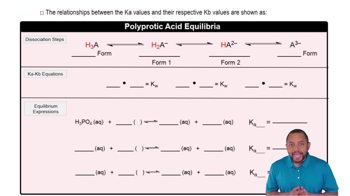
Triprotic Acid Equilibrium

pH Calculation

pH is a measure of the hydrogen ion concentration in a solution, calculated using the formula pH = -log[H+]. For weak acids, the pH can be determined from the equilibrium expression derived from the acid dissociation constant (Ka). This calculation often requires setting up an ICE (Initial, Change, Equilibrium) table to find the concentration of H+ ions at equilibrium.
Video consigliato:
Percorso guidato
02:15
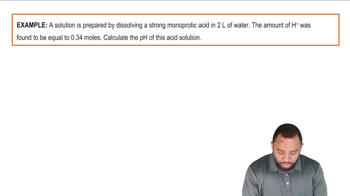
pH Calculation Example

Assumption of Small x

In weak acid calculations, the assumption that 'x' (the change in concentration due to dissociation) is small simplifies the math. This assumption is valid when the initial concentration of the acid is significantly higher than Ka. However, if the initial concentration is low (close to the value of Ka), this assumption may not hold, leading to inaccurate results. Identifying when this assumption is valid is essential for accurate pH calculations.
Video consigliato:
Percorso guidato
04:23
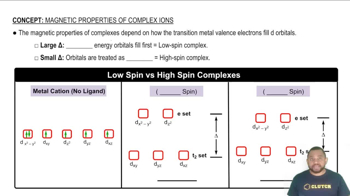
Low-Spin Complexes are associated with large Δ values and High-Spin Complexes are associated with small Δ values.