Ch.17 - Acids and Bases
Tro - Chemistry: A Molecular Approach 6th Edition
Tro6th EditionChemistry: A Molecular ApproachISBN: 9780137832217Non è quello che usi tu?Cambia libro di testo
Capitolo 17, Problema 35c

Write the formula for the conjugate acid of each base. c. HCO3–

Guida verificata passo dopo passo
1
Identify the base in the problem: \( \text{HCO}_3^- \).
Recall that a conjugate acid is formed by adding a proton (\( \text{H}^+ \)) to the base.
Add a proton to the base \( \text{HCO}_3^- \) to form the conjugate acid.
The addition of \( \text{H}^+ \) to \( \text{HCO}_3^- \) results in \( \text{H}_2\text{CO}_3 \).
Write the formula for the conjugate acid: \( \text{H}_2\text{CO}_3 \).

Risposta video verificata per un problema simile:

Questa soluzione video è stata consigliata dai nostri tutor come utile per risolvere questo problema.
Durata del video:
32s

Concetti chiave

Ecco i concetti essenziali che devi comprendere per rispondere correttamente alla domanda.

Conjugate Acid-Base Pair

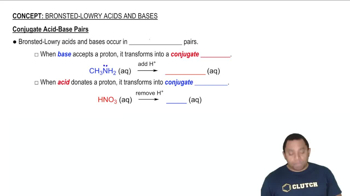
In acid-base chemistry, a conjugate acid is formed when a base accepts a proton (H+). This relationship is part of the Brønsted-Lowry theory, which defines acids as proton donors and bases as proton acceptors. Each acid-base pair differs by one proton, illustrating the dynamic nature of proton transfer in chemical reactions.
Video consigliato:
Percorso guidato
01:30
Conjugate Acid-Base Pairs

Bicarbonate Ion (HCO3–)

The bicarbonate ion (HCO3–) is an important buffer in biological systems and plays a crucial role in maintaining pH balance. It can act as a base by accepting a proton to form carbonic acid (H2CO3), which is essential in processes like respiration and metabolic regulation. Understanding its behavior is key to identifying its conjugate acid.
Video consigliato:

Protonation

Protonation is the process by which a molecule gains a proton (H+), resulting in the formation of a conjugate acid. This process is fundamental in acid-base reactions, as it alters the charge and reactivity of the molecule. For the bicarbonate ion, protonation leads to the formation of carbonic acid, illustrating how bases can transform into acids through protonation.
Video consigliato:
Percorso guidato
01:38
Neutron-to-Proton Plot