Ch.17 - Acids and Bases
Tro - Chemistry: A Molecular Approach 6th Edition
Tro6th EditionChemistry: A Molecular ApproachISBN: 9780137832217Non è quello che usi tu?Cambia libro di testo
Capitolo 17, Problema 36c

Write the formula for the conjugate base of each acid. c. HI

Guida verificata passo dopo passo
1
Identify the acid in the problem: HI (hydroiodic acid).
Recall that a conjugate base is formed by removing a proton (H⁺) from the acid.
Remove one hydrogen ion (H⁺) from HI, which leaves you with the iodide ion (I⁻).
Write the formula for the conjugate base: I⁻.
Understand that the conjugate base of an acid is the species that remains after the acid has donated a proton.

Risposta video verificata per un problema simile:

Questa soluzione video è stata consigliata dai nostri tutor come utile per risolvere questo problema.
Durata del video:
33s

Concetti chiave

Ecco i concetti essenziali che devi comprendere per rispondere correttamente alla domanda.

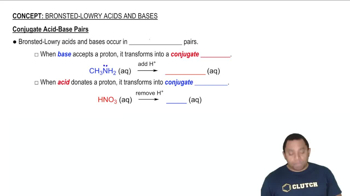
Conjugate Acid-Base Pairs

In acid-base chemistry, a conjugate acid-base pair consists of two species that differ by the presence of a proton (H+). When an acid donates a proton, it forms its conjugate base, while the base that accepts the proton becomes its conjugate acid. Understanding this relationship is crucial for identifying the conjugate base of any given acid.
Video consigliato:
Percorso guidato
01:30
Conjugate Acid-Base Pairs

Strong Acids and Their Conjugate Bases

Strong acids, such as hydroiodic acid (HI), completely dissociate in water, meaning they release all their protons. The conjugate base of a strong acid is typically a weak base, which does not readily accept protons. Recognizing the strength of the acid helps predict the properties of its conjugate base.
Video consigliato:
Percorso guidato
01:09
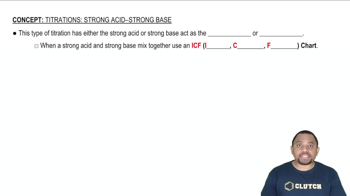
Strong Acid-Strong Base Titration

Chemical Formulas and Ion Representation

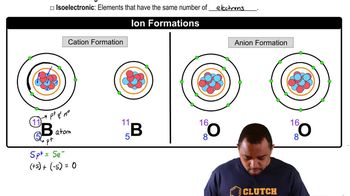
Chemical formulas represent the composition of substances, including ions. The conjugate base of an acid can be represented by removing a hydrogen ion (H+) from the acid's formula. For HI, the removal of H+ results in the iodide ion (I-), which is the conjugate base of hydroiodic acid.
Video consigliato: