Ch.19 - Free Energy & Thermodynamics
Tro - Chemistry: A Molecular Approach 6th Edition
Tro6th EditionChemistry: A Molecular ApproachISBN: 9780137832217Non è quello che usi tu?Cambia libro di testo
Capitolo 19, Problema 94a

Consider this reaction occurring at 298 K: BaCO3(s) ⇌ BaO(s) + CO2(g) a. Show that the reaction is not spontaneous under standard conditions by calculating ΔG°rxn.

Guida verificata passo dopo passo
1
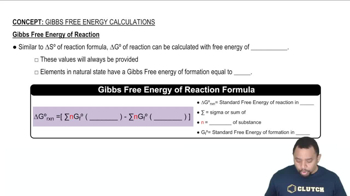
insert step 1> Calculate the standard Gibbs free energy of formation (\( \Delta G_f^\circ \)) for each substance involved in the reaction: BaCO3(s), BaO(s), and CO2(g). These values can be found in a standard thermodynamic table.
insert step 2> Use the formula for the standard Gibbs free energy change of the reaction: \( \Delta G_{rxn}^\circ = \sum \Delta G_f^\circ (\text{products}) - \sum \Delta G_f^\circ (\text{reactants}) \).
insert step 3> Substitute the \( \Delta G_f^\circ \) values for BaO(s) and CO2(g) as products and BaCO3(s) as the reactant into the equation from Step 2.
insert step 4> Perform the arithmetic to find \( \Delta G_{rxn}^\circ \).
insert step 5> Interpret the result: If \( \Delta G_{rxn}^\circ > 0 \), the reaction is non-spontaneous under standard conditions.

Risposta video verificata per un problema simile:

Questa soluzione video è stata consigliata dai nostri tutor come utile per risolvere questo problema.
Durata del video:
7m

Concetti chiave

Ecco i concetti essenziali che devi comprendere per rispondere correttamente alla domanda.

Gibbs Free Energy (ΔG)

Gibbs Free Energy is a thermodynamic potential that helps predict the spontaneity of a reaction. A negative ΔG indicates that a reaction can occur spontaneously, while a positive ΔG suggests non-spontaneity. The standard Gibbs free energy change (ΔGrxn °) is calculated under standard conditions (1 atm, 298 K) and is essential for determining the favorability of the reaction.
Video consigliato:
Percorso guidato
01:51
Gibbs Free Energy of Reactions

Standard State Conditions

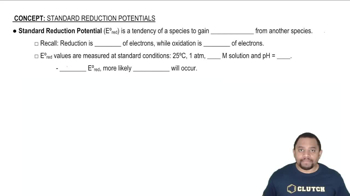
Standard state conditions refer to a set of specific conditions used to measure the properties of substances, typically at 1 bar (or 1 atm) pressure and a specified temperature, usually 298 K. These conditions provide a consistent basis for comparing thermodynamic data, such as enthalpy, entropy, and Gibbs free energy, which are crucial for calculating ΔGrxn °.
Video consigliato:
Percorso guidato
01:10
Standard Reduction Potentials

Equilibrium Constant (K)

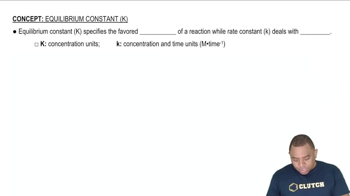
The equilibrium constant (K) is a dimensionless value that expresses the ratio of the concentrations of products to reactants at equilibrium for a given reaction. It is related to the standard Gibbs free energy change by the equation ΔGrxn ° = -RT ln(K). Understanding K helps in assessing the position of equilibrium and the spontaneity of the reaction under standard conditions.
Video consigliato:
Percorso guidato
01:14
Equilibrium Constant K
Pratica correlata
Domanda del libro di testo

Consider this reaction occurring at 298 K: N2O(g) + NO2(g) ⇌ 3 NO(g) a. Show that the reaction is not spontaneous under standard conditions by calculating ΔG°rxn.

1400
views

Domanda del libro di testo

Living organisms use energy from the metabolism of food to create an energy-rich molecule called adenosine triphosphate (ATP). The ATP acts as an energy source for a variety of reactions that the living organism must carry out to survive. ATP provides energy through its hydrolysis, which can be symbolized as follows: ATP(aq) + H2O(l) → ADP(aq) + Pi(aq) ΔGrxn ° = -30.5 kJ where ADP represents adenosine diphosphate and Pi represents an inorganic phosphate group (such as HPO42-). a. Calculate the equilibrium constant, K, for the given reaction at 298 K.

1492
views
Domanda del libro di testo

Consider this reaction occurring at 298 K: N2O(g) + NO2(g) ⇌ 3 NO(g) c. Can the reaction be made more spontaneous by an increase or decrease in temperature? If so, what temperature is required to make the reaction spontaneous under standard conditions?

499
views
Domanda del libro di testo

Consider this reaction occurring at 298 K: N2O(g) + NO2(g) ⇌ 3 NO(g) b. If a reaction mixture contains only N2O and NO2 at partial pressures of 1.0 atm each, the reaction will be spontaneous until some NO forms in the mixture. What maximum partial pressure of NO builds up before the reaction ceases to be spontaneous?

1806
views
Domanda del libro di testo

Consider this reaction occurring at 298 K: BaCO3(s) ⇌ BaO(s) + CO2( g) b. If BaCO3 is placed in an evacuated flask, what is the partial pressure of CO2 when the reaction reaches equilibrium?

1693
views
Domanda del libro di testo

Consider this reaction occurring at 298 K: BaCO3(s) ⇌ BaO(s) + CO2(g) c. Can the reaction be made more spontaneous by an increase or decrease in temperature? If so, at what temperature is the partial pressure of carbon dioxide 1.0 atm?

1004
views