Consider this reaction occurring at 298 K: N2O(g) + NO2(g) ⇌ 3 NO(g) a. Show that the reaction is not spontaneous under standard conditions by calculating ΔG°rxn.
Ch.19 - Free Energy & Thermodynamics

Tro6th EditionChemistry: A Molecular ApproachISBN: 9780137832217Non è quello che usi tu?Cambia libro di testo
Capitolo 19, Problema 93b
Consider this reaction occurring at 298 K: N2O(g) + NO2(g) ⇌ 3 NO(g) b. If a reaction mixture contains only N2O and NO2 at partial pressures of 1.0 atm each, the reaction will be spontaneous until some NO forms in the mixture. What maximum partial pressure of NO builds up before the reaction ceases to be spontaneous?
Guida verificata passo dopo passo1
Step 1: The first step is to write down the reaction and the given information. The reaction is N2O(g) + NO2(g) ⇌ 3NO(g). The partial pressures of N2O and NO2 are both 1.0 atm.
Step 2: The reaction will be spontaneous until some NO forms in the mixture. This means that the reaction will proceed in the forward direction until the system reaches equilibrium. At equilibrium, the rate of the forward reaction equals the rate of the reverse reaction.
Step 3: To find the maximum partial pressure of NO that builds up before the reaction ceases to be spontaneous, we need to use the equilibrium constant expression for the reaction. The equilibrium constant expression for a reaction is the ratio of the product of the concentrations (or in this case, partial pressures) of the products to the product of the concentrations (or partial pressures) of the reactants, each raised to the power of their stoichiometric coefficients in the balanced chemical equation.
Step 4: The equilibrium constant expression for this reaction is Kp = [NO]^3 / ([N2O][NO2]). We need to solve this equation for [NO] when Kp = 1, because the reaction is at equilibrium when the reaction quotient Q equals the equilibrium constant K. When Kp = 1, the reaction is equally likely to proceed in the forward or reverse direction, so the reaction is no longer spontaneous in the forward direction.
Step 5: To solve for [NO], we need to know the values of [N2O] and [NO2] at equilibrium. Since the reaction is no longer spontaneous when [NO] reaches its maximum value, we can assume that all of the N2O and NO2 has been converted into NO. Therefore, [N2O] = [NO2] = 0 at equilibrium. Substituting these values into the equilibrium constant expression gives [NO] = (Kp)^1/3.

Risposta video verificata per un problema simile:
Questa soluzione video è stata consigliata dai nostri tutor come utile per risolvere questo problema.
Durata del video:
6mConcetti chiave
Ecco i concetti essenziali che devi comprendere per rispondere correttamente alla domanda.
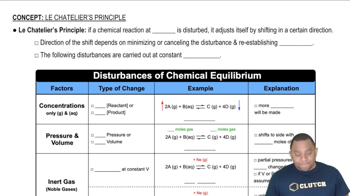
Le Chatelier's Principle
Le Chatelier's Principle states that if a dynamic equilibrium is disturbed by changing the conditions, the position of equilibrium shifts to counteract the change. In the context of the given reaction, if the concentration of reactants (N2O and NO2) is altered, the system will adjust to either produce more products (NO) or revert to reactants to restore equilibrium.
Video consigliato:
Percorso guidato
Le Chatelier's Principle
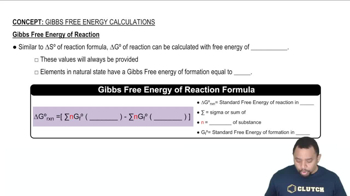
Gibbs Free Energy
Gibbs Free Energy (G) is a thermodynamic potential that measures the maximum reversible work obtainable from a thermodynamic system at constant temperature and pressure. A reaction is spontaneous when the change in Gibbs Free Energy (ΔG) is negative. The relationship between the partial pressures of the gases and ΔG can help determine the maximum pressure of NO before the reaction ceases to be spontaneous.
Video consigliato:
Percorso guidato
Gibbs Free Energy of Reactions
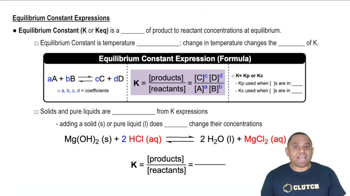
Equilibrium Constant (Kp)
The equilibrium constant (Kp) for a reaction at a given temperature is the ratio of the partial pressures of the products raised to their stoichiometric coefficients to the partial pressures of the reactants raised to their coefficients. For the reaction provided, Kp can be calculated using the partial pressures of N2O, NO2, and NO, allowing us to find the maximum partial pressure of NO that can exist before the reaction reaches equilibrium and becomes non-spontaneous.
Video consigliato:
Percorso guidato
Equilibrium Constant Expressions
Pratica correlata
Domanda del libro di testo
1400
views
Domanda del libro di testo
Consider this reaction occurring at 298 K: N2O(g) + NO2(g) ⇌ 3 NO(g) c. Can the reaction be made more spontaneous by an increase or decrease in temperature? If so, what temperature is required to make the reaction spontaneous under standard conditions?
499
views
Domanda del libro di testo
Consider this reaction occurring at 298 K: BaCO3(s) ⇌ BaO(s) + CO2( g) b. If BaCO3 is placed in an evacuated flask, what is the partial pressure of CO2 when the reaction reaches equilibrium?
1693
views
Domanda del libro di testo
Consider this reaction occurring at 298 K: BaCO3(s) ⇌ BaO(s) + CO2(g) a. Show that the reaction is not spontaneous under standard conditions by calculating ΔG°rxn.
391
views