Ch.19 - Free Energy & Thermodynamics
Tro - Chemistry: A Molecular Approach 6th Edition
Tro6th EditionChemistry: A Molecular ApproachISBN: 9780137832217Non è quello che usi tu?Cambia libro di testo
Capitolo 19, Problema 90

Nitrogen dioxide, a pollutant in the atmosphere, can combine with water to form nitric acid. One of the possible reactions is shown here. Calculate ΔG° and Kp for this reaction at 25 °C and comment on the spontaneity of the reaction. 3 NO2(g) + H2O(l)→ 2 HNO3(aq) + NO(g)

Guida verificata passo dopo passo
1
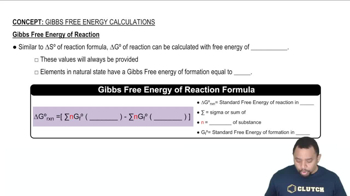
Step 1: To calculate the standard Gibbs free energy change (ΔG°), we need to know the standard Gibbs free energies of formation (ΔGf°) for all substances involved in the reaction. These values can be found in a standard thermodynamic table. The formula to calculate ΔG° is: ΔG° = Σ (ΔGf° products) - Σ (ΔGf° reactants).
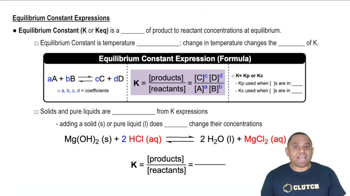
Step 2: Once you have the ΔG°, you can calculate the equilibrium constant (Kp) using the formula: ΔG° = -RT ln(Kp), where R is the gas constant (8.314 J/(mol·K)) and T is the temperature in Kelvin (25°C = 298.15 K). Rearrange the formula to solve for Kp: Kp = e^(-ΔG°/(RT)).
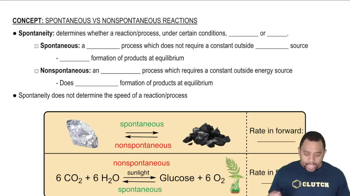
Step 3: If ΔG° is negative, the reaction is spontaneous in the forward direction. If ΔG° is positive, the reaction is non-spontaneous in the forward direction and spontaneous in the reverse direction. If ΔG° is zero, the reaction is at equilibrium.
Step 4: If Kp is greater than 1, the reaction will proceed to the right, favoring the products. If Kp is less than 1, the reaction will proceed to the left, favoring the reactants. If Kp equals 1, the reaction is at equilibrium.
Step 5: Based on the calculated values of ΔG° and Kp, comment on the spontaneity of the reaction.

Risposta video verificata per un problema simile:

Questa soluzione video è stata consigliata dai nostri tutor come utile per risolvere questo problema.
Durata del video:
5m

Concetti chiave

Ecco i concetti essenziali che devi comprendere per rispondere correttamente alla domanda.

Gibbs Free Energy (ΔG°)

Gibbs Free Energy (ΔG°) is a thermodynamic potential that measures the maximum reversible work obtainable from a thermodynamic process at constant temperature and pressure. A negative ΔG° indicates that a reaction is spontaneous, while a positive ΔG° suggests non-spontaneity. The value of ΔG° can be calculated using standard enthalpy and entropy changes, providing insight into the favorability of a reaction.
Video consigliato:
Percorso guidato
01:51
Gibbs Free Energy of Reactions

Equilibrium Constant (Kp)

The equilibrium constant (Kp) is a dimensionless value that expresses the ratio of the concentrations of products to reactants at equilibrium for a given reaction, raised to the power of their stoichiometric coefficients. For gaseous reactions, Kp is calculated using partial pressures. The relationship between ΔG° and Kp is given by the equation ΔG° = -RT ln(Kp), linking thermodynamics with chemical equilibrium.
Video consigliato:
Percorso guidato
03:20
Equilibrium Constant Expressions

Spontaneity of Reactions

The spontaneity of a reaction refers to its ability to proceed without external intervention. It is determined by the sign of ΔG°; if ΔG° is negative, the reaction is spontaneous under standard conditions. Factors such as temperature, pressure, and concentration can influence spontaneity, and understanding these factors is crucial for predicting the behavior of chemical reactions in various environments.
Video consigliato:
Percorso guidato
04:20
Spontaneity of Processes