Ch.19 - Free Energy & Thermodynamics
Tro - Chemistry: A Molecular Approach 6th Edition
Tro6th EditionChemistry: A Molecular ApproachISBN: 9780137832217Non è quello che usi tu?Cambia libro di testo
Capitolo 19, Problema 89

Our atmosphere is composed primarily of nitrogen and oxygen, which coexist at 25 °C without reacting to any significant extent. However, the two gases can react to form nitrogen monoxide according to the reaction: N2(g) + O2(g) → 2 NO(g). a. Calculate ΔG° and Kp for this reaction at 298 K. Is the reaction spontaneous? b. Estimate ΔG° at 2000 K. Does the reaction become more spontaneous as temperature increases?

Guida verificata passo dopo passo
1
insert step 1: Identify the standard Gibbs free energy change (ΔG°) equation: ΔG° = ΔH° - TΔS°. You will need the standard enthalpy change (ΔH°) and the standard entropy change (ΔS°) for the reaction.
insert step 2: Look up or calculate the standard enthalpy change (ΔH°) and the standard entropy change (ΔS°) for the reaction using standard thermodynamic tables.
insert step 3: Calculate ΔG° at 298 K using the equation from step 1.
insert step 4: Use the relationship between ΔG° and the equilibrium constant (Kp) at a given temperature: ΔG° = -RT ln(Kp), where R is the gas constant and T is the temperature in Kelvin. Solve for Kp.
insert step 5: To estimate ΔG° at 2000 K, use the same equation from step 1, assuming ΔH° and ΔS° are approximately constant over the temperature range. Compare the ΔG° values at 298 K and 2000 K to determine if the reaction becomes more spontaneous at higher temperatures.

Concetti chiave

Ecco i concetti essenziali che devi comprendere per rispondere correttamente alla domanda.

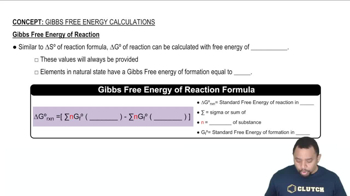
Gibbs Free Energy (ΔG)

Gibbs Free Energy (ΔG) is a thermodynamic potential that helps predict the spontaneity of a reaction at constant temperature and pressure. A negative ΔG indicates that a reaction is spontaneous, while a positive ΔG suggests non-spontaneity. The standard Gibbs free energy change (ΔG°) is calculated using standard enthalpy and entropy values, providing insight into the favorability of a reaction under standard conditions.
Video consigliato:
Percorso guidato
01:51
Gibbs Free Energy of Reactions

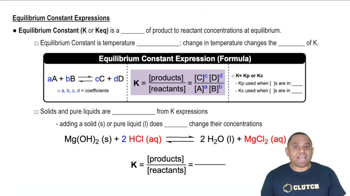
Equilibrium Constant (Kp)

The equilibrium constant (Kp) is a dimensionless value that expresses the ratio of the concentrations of products to reactants at equilibrium for a given reaction at a specific temperature. For the reaction N2(g) + O2(g) → 2 NO(g), Kp can be calculated using the partial pressures of the gases involved. A larger Kp value indicates a greater tendency for the reaction to favor product formation at equilibrium.
Video consigliato:
Percorso guidato
03:20
Equilibrium Constant Expressions

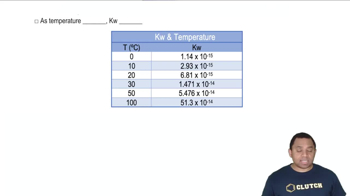
Temperature Dependence of Spontaneity

The spontaneity of a reaction can be temperature-dependent, as described by the Gibbs free energy equation: ΔG = ΔH - TΔS. Here, ΔH is the change in enthalpy, ΔS is the change in entropy, and T is the temperature in Kelvin. As temperature increases, the TΔS term can become significant, potentially making a reaction more spontaneous if ΔS is positive, indicating an increase in disorder.
Video consigliato:
Percorso guidato
01:24
Kw Temperature Dependence