
Ch.19 - Free Energy & Thermodynamics
Tro - Chemistry: A Molecular Approach 6th Edition
Tro6th EditionChemistry: A Molecular ApproachISBN: 9780137832217Non è quello che usi tu?Cambia libro di testo
Capitolo 19, Problema 35a

Without doing any calculations, determine the sign of ΔSsys for each chemical reaction. a. 2 KClO3(s) → 2 KCl(s) + 3 O2(g) c. Na(s) + 2 Cl2(g) → NaCl(s) d. N2(g) + 3 H2(g) → 2 NH3(g)

Guida verificata passo dopo passo
1
Identify the states of matter for each substance in the reaction.
Recognize that entropy (ΔS) is a measure of disorder or randomness in a system.
Note that gases generally have higher entropy than solids due to their greater freedom of movement.
Compare the number of moles of gaseous products to the number of moles of gaseous reactants.
Conclude that if the number of moles of gas increases, ΔS_sys is likely positive, indicating an increase in entropy.

Risposta video verificata per un problema simile:

Questa soluzione video è stata consigliata dai nostri tutor come utile per risolvere questo problema.

Concetti chiave

Ecco i concetti essenziali che devi comprendere per rispondere correttamente alla domanda.

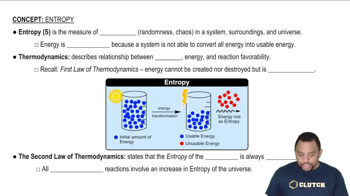
Entropy (ΔS)

Entropy, denoted as ΔS, is a measure of the disorder or randomness in a system. In chemical reactions, an increase in the number of gas molecules typically leads to an increase in entropy, while a decrease in the number of gas molecules can result in a decrease in entropy. Understanding how the states of matter and the number of particles change during a reaction is crucial for predicting the sign of ΔS.
Video consigliato:
Percorso guidato
02:46
Entropy in Thermodynamics

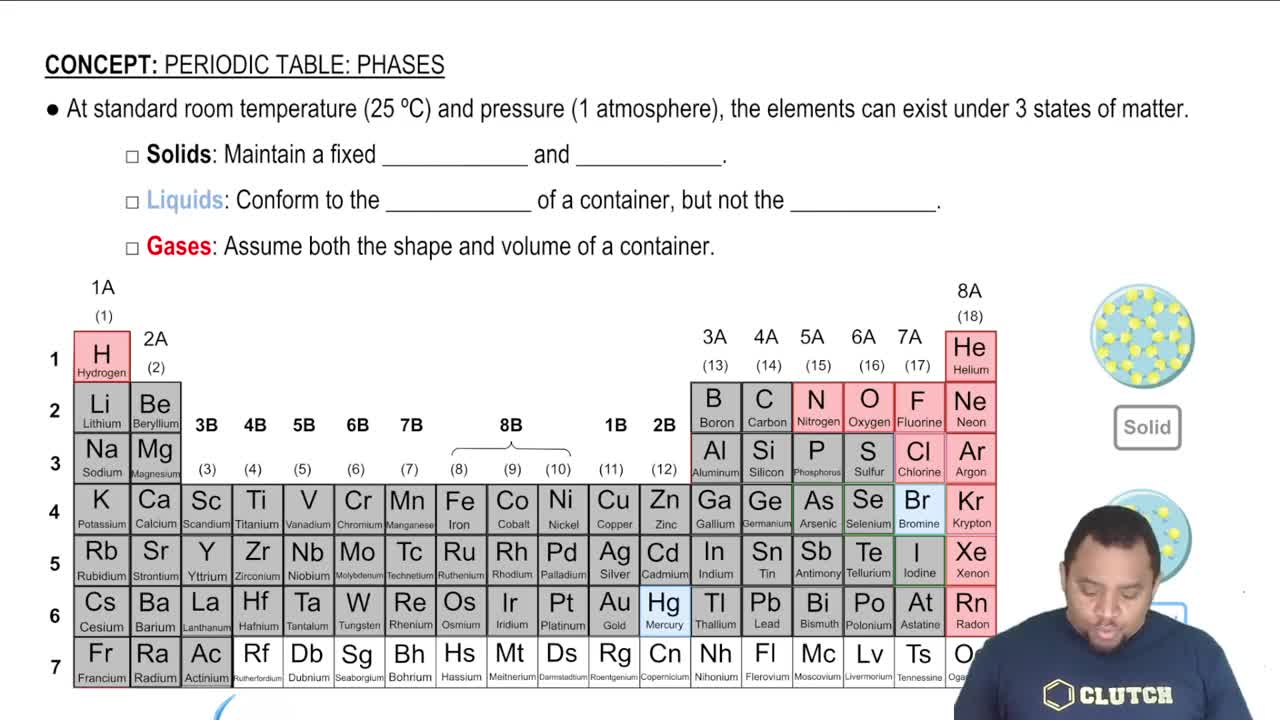
States of Matter

The states of matter—solid, liquid, and gas—play a significant role in determining the entropy of a system. Solids have a fixed structure and lower entropy, while gases have more freedom of movement and higher entropy. In the given reaction, the transition from solid KClO3 to gaseous O2 indicates a change in the state of matter that affects the overall disorder of the system.
Video consigliato:
Percorso guidato
03:25
Element States of Matter

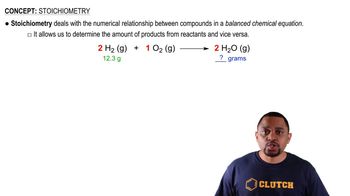
Chemical Reaction Stoichiometry

Chemical reaction stoichiometry involves the quantitative relationships between reactants and products in a chemical reaction. In the provided reaction, the stoichiometry shows that 2 moles of solid KClO3 produce 3 moles of gaseous O2 and 2 moles of solid KCl. This increase in the number of gaseous products relative to the reactants suggests an increase in entropy, which is essential for determining the sign of ΔS.
Video consigliato:
Percorso guidato
01:16
Stoichiometry Concept
Pratica correlata
Domanda del libro di testo

Without doing any calculations, determine the signs of ΔSsys and ΔSsurr for each chemical reaction. In addition, predict under what temperatures (all temperatures, low temperatures, or high temperatures), if any, the reaction is spontaneous. c. C3H8(g) + 5 O2(g) → 3 CO2(g) + 4 H2O(g) ΔH°rxn = -2044 kJ

Domanda del libro di testo

Calculate the change in entropy that occurs in the system when 1.50 mol of diethyl ether (C4H10O) condenses from a gas to a liquid at its normal boiling point (34.6 °C). See Table 12.7 for heats of vaporization.

Domanda del libro di testo

Calculate the change in entropy that occurs in the system when 1.50 mol of isopropyl alcohol (C3H8O) melts at its melting point (-89.5 °C). See Table 12.9 for heats of fusion.

1
views
Domanda del libro di testo

Without doing any calculations, determine the signs of ΔSsys and ΔS surr for each chemical reaction. In addition, predict under what temperatures (all temperatures, low temperatures, or high temperatures), if any, the reaction is spontaneous. a. C3H8(g) + 5 O2(g) → 3 CO2(g) + 4 H2O(g) ΔH°rxn = -2044 kJ

1
views
Domanda del libro di testo

Without doing any calculations, determine the sign of ΔSsys for each chemical reaction. b. CH2=CH2( g) + H2( g) → CH3CH3( g)

463
views
1
rank
Domanda del libro di testo

Two systems, each composed of three particles represented by circles, have 30 J of total energy. How many energetically equivalent ways can you distribute the particles in each system? Which system has greater entropy?

1463
views