Ch.22 - Organic Chemistry
Tro - Chemistry: A Molecular Approach 6th Edition
Tro6th EditionChemistry: A Molecular ApproachISBN: 9780137832217Non è quello che usi tu?Cambia libro di testo
Capitolo 22, Problema 62a

Complete each hydrogenation reaction. a.

Guida verificata passo dopo passo
1
Identify the type of hydrocarbon involved in the hydrogenation reaction. Typically, hydrogenation reactions involve alkenes or alkynes, which contain double or triple bonds, respectively.
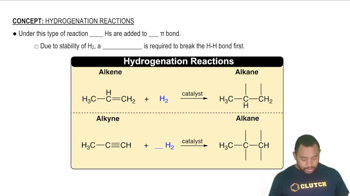
Write the general equation for the hydrogenation reaction. For an alkene, the reaction is: \[ \text{Alkene} + \text{H}_2 \rightarrow \text{Alkane} \]. For an alkyne, it is: \[ \text{Alkyne} + 2\text{H}_2 \rightarrow \text{Alkane} \].
Determine the structure of the starting hydrocarbon. Identify the location of the double or triple bond that will be hydrogenated.
Add hydrogen atoms across the double or triple bond. For a double bond, add one hydrogen atom to each carbon atom involved in the bond. For a triple bond, add two hydrogen atoms to each carbon atom.
Draw the structure of the resulting alkane, ensuring that all carbon atoms have four bonds and that the molecule is fully saturated with hydrogen.

Risposta video verificata per un problema simile:

Questa soluzione video è stata consigliata dai nostri tutor come utile per risolvere questo problema.
Durata del video:
46s

Concetti chiave

Ecco i concetti essenziali che devi comprendere per rispondere correttamente alla domanda.

Hydrogenation

Hydrogenation is a chemical reaction that involves the addition of hydrogen (H2) to an unsaturated compound, typically an alkene or alkyne, converting it into a saturated compound. This process is commonly catalyzed by metals such as palladium, platinum, or nickel, which facilitate the breaking of the double or triple bonds in the reactants, allowing hydrogen to bond with the carbon atoms.
Video consigliato:
Percorso guidato
01:22
Hydrogenation Reactions

Catalysts in Reactions

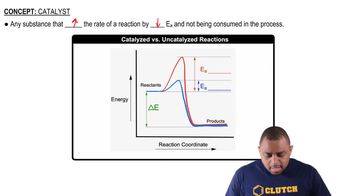
Catalysts are substances that increase the rate of a chemical reaction without being consumed in the process. In hydrogenation reactions, catalysts lower the activation energy required for the reaction to occur, enabling the addition of hydrogen to unsaturated hydrocarbons more efficiently. Understanding the role of catalysts is crucial for optimizing reaction conditions and yields in organic chemistry.
Video consigliato:
Percorso guidato
01:59
Catalyzed vs. Uncatalyzed Reactions

Saturation of Organic Compounds

Saturation refers to the presence of single bonds between carbon atoms in organic compounds, as opposed to double or triple bonds found in unsaturated compounds. The hydrogenation process transforms unsaturated compounds into saturated ones, which can significantly alter their chemical properties, stability, and reactivity. Recognizing the difference between saturated and unsaturated compounds is essential for predicting the outcomes of hydrogenation reactions.
Video consigliato:
Percorso guidato
02:26
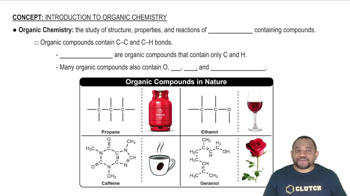
Introduction to Organic Chemistry