Ch.22 - Organic Chemistry
Tro - Chemistry: A Molecular Approach 6th Edition
Tro6th EditionChemistry: A Molecular ApproachISBN: 9780137832217Non è quello che usi tu?Cambia libro di testo
Capitolo 22, Problema 61c

Complete each hydrogenation reaction. c.

Guida verificata passo dopo passo
1
Identify the reactant in the hydrogenation reaction. Typically, this will be an unsaturated hydrocarbon, such as an alkene or alkyne, which contains double or triple bonds.
Determine the type of hydrogenation reaction. In this case, it is likely a catalytic hydrogenation, where hydrogen gas (H_2) is added across the double or triple bonds in the presence of a catalyst, such as palladium (Pd), platinum (Pt), or nickel (Ni).
Write the balanced chemical equation for the hydrogenation reaction. For example, if the reactant is an alkene (C=C), the reaction would be: C=C + H_2 → C-C, where the double bond is converted to a single bond.
Consider the stereochemistry of the reaction. In catalytic hydrogenation, the addition of hydrogen is typically syn, meaning both hydrogen atoms add to the same side of the double bond, resulting in a cis product if applicable.
Verify the product structure. Ensure that all double or triple bonds in the reactant have been converted to single bonds in the product, and that the molecular formula is consistent with the addition of hydrogen.

Risposta video verificata per un problema simile:

Questa soluzione video è stata consigliata dai nostri tutor come utile per risolvere questo problema.
Durata del video:
48s

Concetti chiave

Ecco i concetti essenziali che devi comprendere per rispondere correttamente alla domanda.

Hydrogenation

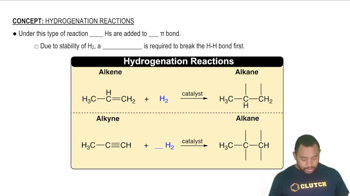
Hydrogenation is a chemical reaction that involves the addition of hydrogen (H2) to an unsaturated compound, typically an alkene or alkyne, converting it into a saturated compound. This process is commonly used in organic chemistry to reduce double or triple bonds, resulting in alkanes. Catalysts, such as palladium, platinum, or nickel, are often employed to facilitate the reaction and increase its efficiency.
Video consigliato:
Percorso guidato
01:22
Hydrogenation Reactions

Reaction Mechanism

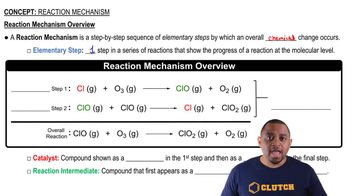
The reaction mechanism describes the step-by-step sequence of elementary reactions by which a chemical change occurs. Understanding the mechanism of hydrogenation is crucial, as it involves the formation of a transition state and the breaking and forming of bonds. This knowledge helps predict the products of the reaction and the conditions required for it to proceed effectively.
Video consigliato:
Percorso guidato
03:06
Reaction Mechanism Overview

Saturation and Unsaturation

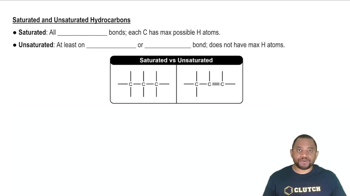
In organic chemistry, saturation refers to the presence of single bonds between carbon atoms in a molecule, while unsaturation indicates the presence of double or triple bonds. Saturated compounds, such as alkanes, are generally more stable and less reactive than unsaturated compounds, like alkenes and alkynes. Recognizing the degree of saturation is essential for predicting the outcomes of hydrogenation reactions.
Video consigliato:
Percorso guidato
02:12
Saturated and Unsaturated Hydrocarbons