Ch.22 - Organic Chemistry
Tro - Chemistry: A Molecular Approach 6th Edition
Tro6th EditionChemistry: A Molecular ApproachISBN: 9780137832217Non è quello che usi tu?Cambia libro di testo
Capitolo 22, Problema 79

Determine the product of the addition reaction.

Guida verificata passo dopo passo
1
insert step 1> Identify the type of addition reaction involved. Common types include hydrogenation, halogenation, hydrohalogenation, and hydration.
insert step 2> Determine the reactants involved in the reaction. Typically, an addition reaction involves an alkene or alkyne and another molecule such as H2, X2 (where X is a halogen), HX, or H2O.
insert step 3> Analyze the structure of the alkene or alkyne to identify the site of the double or triple bond where the addition will occur.
insert step 4> Apply the Markovnikov's rule if applicable, which states that in the addition of HX to an alkene, the hydrogen atom will attach to the carbon with the greater number of hydrogen atoms already attached, and the halide will attach to the carbon with fewer hydrogen atoms.
insert step 5> Draw the structure of the product, showing the addition of the atoms or groups across the double or triple bond, resulting in a saturated or less unsaturated compound.

Risposta video verificata per un problema simile:

Questa soluzione video è stata consigliata dai nostri tutor come utile per risolvere questo problema.
Durata del video:
2m

Concetti chiave

Ecco i concetti essenziali che devi comprendere per rispondere correttamente alla domanda.

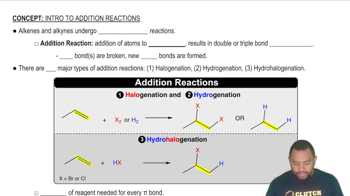
Addition Reactions

Addition reactions are a type of chemical reaction where two or more reactants combine to form a single product. This process typically involves unsaturated compounds, such as alkenes or alkynes, which have double or triple bonds that can be broken to allow new bonds to form. Understanding the mechanism of these reactions is crucial for predicting the products formed.
Video consigliato:
Percorso guidato
02:55
Addition Reactions

Functional Groups

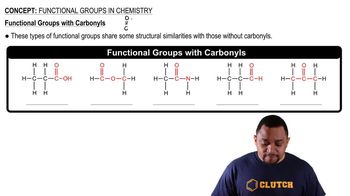
Functional groups are specific groups of atoms within molecules that are responsible for the characteristic chemical reactions of those molecules. In addition reactions, the presence of certain functional groups, such as alkenes, can significantly influence the outcome of the reaction. Identifying these groups helps in determining the expected products of the reaction.
Video consigliato:
Percorso guidato
01:32
Carbonyl Functional Groups

Reaction Mechanisms

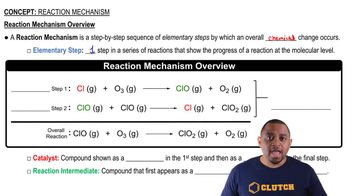
Reaction mechanisms describe the step-by-step sequence of elementary reactions by which overall chemical change occurs. In the context of addition reactions, understanding the mechanism allows chemists to predict the formation of products, including stereochemistry and regioselectivity. This knowledge is essential for accurately determining the final product of the reaction.
Video consigliato:
Percorso guidato
03:06
Reaction Mechanism Overview