Ch.6 - Gases
Tro - Chemistry: A Molecular Approach 6th Edition
Tro6th EditionChemistry: A Molecular ApproachISBN: 9780137832217Non è quello che usi tu?Cambia libro di testo
Capitolo 6, Problema 52

A 2.0-L container of liquid nitrogen is kept in a closet measuring 1.0 m by 1.0 m by 2.0 m. Assuming that the container is completely full, that the temperature is 25.0°C, and that the atmospheric pressure is 1.0 atm, calculate the percent (by volume) of air that is displaced if all of the liquid nitrogen evaporates. (Liquid nitrogen has a density of 0.807 g/mL.)

Guida verificata passo dopo passo
1
Calculate the mass of liquid nitrogen using its volume and density. Use the formula: \( \text{mass} = \text{density} \times \text{volume} \).
Convert the mass of nitrogen to moles using the molar mass of nitrogen (N2), which is approximately 28.02 g/mol. Use the formula: \( \text{moles} = \frac{\text{mass}}{\text{molar mass}} \).
Use the ideal gas law to find the volume of nitrogen gas at 25.0°C and 1.0 atm. The ideal gas law is \( PV = nRT \), where \( P \) is pressure, \( V \) is volume, \( n \) is moles, \( R \) is the ideal gas constant (0.0821 L·atm/mol·K), and \( T \) is temperature in Kelvin.
Convert the temperature from Celsius to Kelvin by adding 273.15 to the Celsius temperature.
Calculate the percent of air displaced by dividing the volume of nitrogen gas by the volume of the closet and multiplying by 100 to get the percentage.

Risposta video verificata per un problema simile:

Questa soluzione video è stata consigliata dai nostri tutor come utile per risolvere questo problema.
Durata del video:
4m

Concetti chiave

Ecco i concetti essenziali che devi comprendere per rispondere correttamente alla domanda.

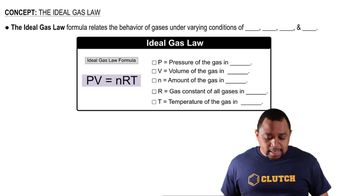
Ideal Gas Law

The Ideal Gas Law relates the pressure, volume, temperature, and number of moles of a gas through the equation PV = nRT. This law is essential for understanding how gases behave under different conditions, particularly when calculating the volume of gas produced from a liquid, such as nitrogen, when it evaporates.
Video consigliato:
Percorso guidato
01:15
Ideal Gas Law Formula

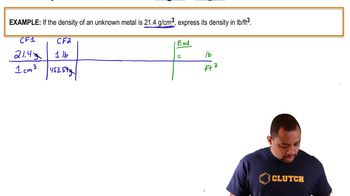
Density and Volume Conversion

Density is defined as mass per unit volume (density = mass/volume). In this problem, converting the mass of liquid nitrogen to volume using its density (0.807 g/mL) is crucial for determining how much space the nitrogen will occupy as a gas after evaporation, which directly impacts the volume of air displaced.
Video consigliato:
Percorso guidato
05:30
Density Conversion Example

Displacement of Air

When a substance evaporates, it occupies space that was previously filled by another substance, in this case, air. The percent volume of air displaced can be calculated by comparing the volume of evaporated nitrogen gas to the total volume of the container, providing insight into how much air is pushed out by the nitrogen.
Video consigliato:
Percorso guidato
01:11
Single Displacement Reactions