
Ch.6 - Gases
Tro - Chemistry: A Molecular Approach 6th Edition
Tro6th EditionChemistry: A Molecular ApproachISBN: 9780137832217Non è quello che usi tu?Cambia libro di testo
Capitolo 6, Problema 51

A piece of dry ice (solid carbon dioxide) with a mass of 22.1 g sublimes (converts from solid to gas) into a large balloon. Assuming that all of the carbon dioxide ends up in the balloon, what is the volume of the balloon at and a pressure of 742 mmHg?

Guida verificata passo dopo passo
1
Identify the given values: mass of CO2 = 22.1 g, pressure = 742 mmHg, temperature = 25°C (which is 298 K).
Convert the mass of CO2 to moles using the molar mass of CO2 (44.01 g/mol).
Use the ideal gas law equation, PV = nRT, to solve for the volume V. Here, P is the pressure in atm, n is the number of moles, R is the ideal gas constant (0.0821 L·atm/mol·K), and T is the temperature in Kelvin.
Convert the pressure from mmHg to atm by dividing by 760 mmHg/atm.
Substitute the values of n, R, T, and P into the ideal gas law equation to solve for V, the volume of the balloon.

Risposta video verificata per un problema simile:

Questa soluzione video è stata consigliata dai nostri tutor come utile per risolvere questo problema.
Durata del video:
7m

Concetti chiave

Ecco i concetti essenziali che devi comprendere per rispondere correttamente alla domanda.

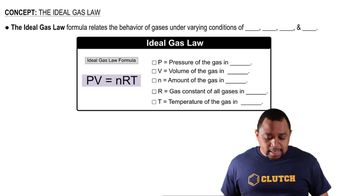
Ideal Gas Law

The Ideal Gas Law is a fundamental equation in chemistry that relates the pressure, volume, temperature, and number of moles of a gas. It is expressed as PV = nRT, where P is pressure, V is volume, n is the number of moles, R is the ideal gas constant, and T is temperature in Kelvin. This law allows us to calculate the volume of a gas when the amount of substance and conditions are known.
Video consigliato:
Percorso guidato
01:15
Ideal Gas Law Formula

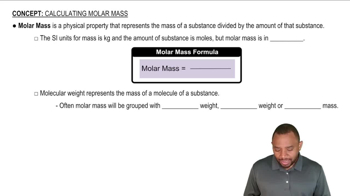
Molar Mass of Carbon Dioxide

The molar mass of carbon dioxide (CO2) is essential for converting the mass of dry ice into moles. The molar mass is calculated by adding the atomic masses of its constituent elements: carbon (12.01 g/mol) and oxygen (16.00 g/mol). Since CO2 has one carbon atom and two oxygen atoms, its molar mass is approximately 44.01 g/mol, which is used to determine the number of moles from the given mass.
Video consigliato:
Percorso guidato
02:11
Molar Mass Concept

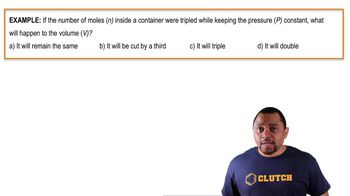
Gas Volume and Pressure Relationship

The relationship between gas volume and pressure is described by Boyle's Law, which states that at constant temperature, the volume of a gas is inversely proportional to its pressure. This means that if the pressure increases, the volume decreases, and vice versa. Understanding this relationship is crucial for calculating the volume of the balloon when the pressure of the gas is provided.
Video consigliato:
Percorso guidato
01:09
Relationship of Volume and Moles Example