Ch.8 - The Quantum-Mechanical Model of the Atom
Tro - Chemistry: A Molecular Approach 6th Edition
Tro6th EditionChemistry: A Molecular ApproachISBN: 9780137832217Non è quello che usi tu?Cambia libro di testo
Capitolo 8, Problema 93

The binding energy of electrons in a metal is 193 kJ/mol. What is the threshold frequency of the metal?

Guida verificata passo dopo passo
1
Understand that the binding energy given is the energy required to remove an electron from the metal surface, which is also known as the work function (\( \phi \)).
Convert the binding energy from kJ/mol to J per electron. Use the conversion factor: 1 kJ = 1000 J and Avogadro's number (\(6.022 \times 10^{23}\) mol\(^{-1}\)).
Use the formula for the work function in terms of frequency: \( \phi = h \nu_0 \), where \( h \) is Planck's constant (\(6.626 \times 10^{-34} \) J·s) and \( \nu_0 \) is the threshold frequency.
Rearrange the formula to solve for the threshold frequency: \( \nu_0 = \frac{\phi}{h} \).
Substitute the converted work function value and Planck's constant into the equation to find the threshold frequency.

Concetti chiave

Ecco i concetti essenziali che devi comprendere per rispondere correttamente alla domanda.

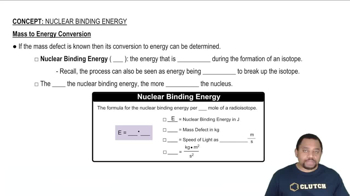
Binding Energy

Binding energy refers to the energy required to remove an electron from an atom or a solid, such as a metal. In this context, it is given as 193 kJ/mol, indicating the energy needed to free one mole of electrons from the metal's surface. This concept is crucial for understanding how tightly electrons are held in a material and how this affects their behavior under external influences, such as light.
Video consigliato:
Percorso guidato
02:06
Nuclear Binding Energy

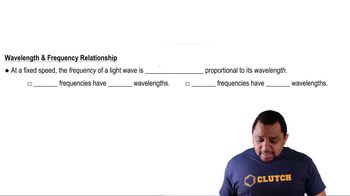
Threshold Frequency

Threshold frequency is the minimum frequency of incident light required to eject electrons from a material's surface in the photoelectric effect. It is directly related to the binding energy of the electrons; if the frequency of the incoming light is equal to or greater than the threshold frequency, electrons can be emitted. This concept is essential for linking the energy of photons to the energy required to liberate electrons from a metal.
Video consigliato:
Percorso guidato
00:31
Frequency-Wavelength Relationship

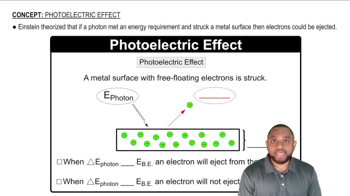
Photoelectric Effect

The photoelectric effect is a phenomenon where electrons are emitted from a material when it absorbs light of sufficient energy. This effect demonstrates the particle nature of light, where photons collide with electrons, transferring energy. Understanding this concept is vital for calculating the threshold frequency, as it illustrates the relationship between light frequency, energy, and electron emission.
Video consigliato:
Percorso guidato
02:31
Photoelectric Effect