
Domanda del libro di testo
Calculate the de Broglie wavelength of a 143-g baseball traveling at 85 mph. Is the wave nature of matter significant for a baseball?

 Guida verificata passo dopo passo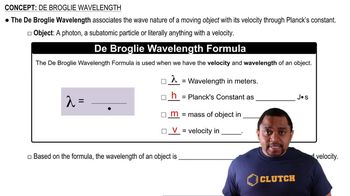
 00:58
00:58
 00:40
00:40 00:50
00:50Calculate the de Broglie wavelength of a 143-g baseball traveling at 85 mph. Is the wave nature of matter significant for a baseball?
Sketch the interference pattern that results from the diffraction of electrons passing through two closely spaced slits.
The smallest atoms can themselves exhibit quantum-mechanical behavior. Calculate the de Broglie wavelength (in pm) of a hydrogen atom traveling at 475 m/s.
The resolution limit of a microscope is roughly equal to the wavelength of light used in producing the image. Electron microscopes use an electron beam (in place of photons) to produce much higher resolution images, about 0.20 nm in modern instruments. Assuming that the resolution of an electron microscope is equal to the de Broglie wavelength of the electrons used, to what speed must the electrons be accelerated to obtain a resolution of 0.20 nm?
A 0.22-caliber handgun fires a 1.9-g bullet at a velocity of 745 m/s. Calculate the de Broglie wavelength of the bullet. Is the wave nature of matter significant for bullets?
A proton in a linear accelerator has a de Broglie wavelength of 132 pm. What is the speed of the proton?