 Indietro
Alternative DNA Conformations and Their Biological Roles
Guida di studio - Note intelligenti
 Appunti personalizzati basati sui tuoi materiali, ampliati con definizioni chiave, esempi e contesto.
DNA and Chromosome Structure
Alternative DNA Conformations
DNA can adopt several structural conformations beyond the canonical B-DNA form. These alternative structures are functionally important and can influence replication, gene expression, recombination, and mutagenesis. The formation of non-B-DNA structures is often induced by environmental changes, protein binding, and superhelical tension.
B-DNA: The most common right-handed double helix, with antiparallel strands and base pairs nearly perpendicular to the helical axis.
A-DNA: Right-handed helix, typically formed under reduced water conditions, with base pairs tilted and shifted to the helix periphery.
Z-DNA: Left-handed helix, found in alternating purine-pyrimidine sequences, with a zigzag backbone and unique groove structure.
Other Structures: Cruciforms, triplexes, quadruplexes, slipped-strand DNA, parallel-stranded DNA, and unpaired DNA regions.
Example: Protein binding can induce transitions between DNA forms, such as the TATA-box binding protein causing local A-DNA formation.
Structural Parameters of DNA Helices
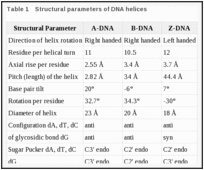
Different DNA conformations are characterized by distinct structural parameters, including helical turn, groove depth, sugar pucker, and base pair tilt. These parameters influence the stability and biological function of each DNA form.
Structural Parameter | A-DNA | B-DNA | Z-DNA |
|---|---|---|---|
Direction of helix rotation | Right handed | Right handed | Left handed |
Residue per helical turn | 11 | 10.5 | 12 |
Axial rise per residue | 2.55 Å | 3.4 Å | 3.7 Å |
Pitch (length of the helix) | 28.2 Å | 35.7 Å | 44.4 Å |
Base pair tilt | 20° | 6° | 7° |
Rotation per residue | 32.7° | 34.3° | 30° |
Diameter of helix | 23 Å | 20 Å | 18 Å |
Configuration dA, dT, etc. | anti | anti | anti/syn |
Sugar Pucker dA, dT, etc. | C3' endo | C2' endo | C2' endo/C3' endo |
DNA Supercoiling
Topological Properties and Biological Relevance
DNA supercoiling refers to the overwinding or underwinding of the DNA double helix, which is a property of topologically closed DNA molecules. Supercoiling is essential for DNA compaction and regulation of biological processes such as replication and transcription.
Linking Number (Lk): The number of times one strand crosses the other in a planar projection. For covalently closed DNA, Lk can only change if a strand is cut and resealed.
Equation:
Superhelical Density (σ):
Free Energy of Supercoiling:
Biological Functions: Facilitates opening of replication origins and promoters, enhancer-promoter communication, and formation of alternative DNA structures.
Example: Negative supercoiling is common in bacterial chromosomes and plasmids, and is regulated by topoisomerases.
Chromosomal Variation
Supercoil-Induced DNA Structures
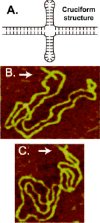
Supercoiling can drive the formation of alternative DNA structures, especially in sequences with defined symmetry such as inverted repeats, mirror repeats, and direct repeats. These structures include cruciforms, Z-DNA, triplex DNA, and slipped-strand DNA.
Cruciform Structure
Cruciforms are formed from inverted repeat sequences that melt and re-pair in a hairpin fashion, creating a four-way junction. They are stabilized by supercoiling and are often found near genetic regulatory regions.
Formation: Requires breaking interstrand hydrogen bonds and forming intrastrand hairpins.
Biological Role: May regulate transcription and recombination by positioning DNA elements.
Z-DNA Structure
Z-DNA is a left-handed helix formed in alternating purine-pyrimidine sequences, such as (CG)n and (TG)n. It is stabilized by high salt concentrations and supercoiling, and is often found near transcription initiation sites.
Structural Features: Zigzag backbone, one deep groove, and alternating sugar pucker.
Biological Role: May facilitate transcription by preventing nucleosome formation.
Triplex DNA Structure
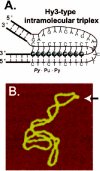
Triplex DNA consists of a B-form duplex and a third strand bound in the major groove via Hoogsteen hydrogen bonds. It can form intermolecularly or intramolecularly in mirror repeat sequences under supercoiling.
Types: Py•Pu•Py and Py•Pu•Pu triplexes, with base triads such as T•A•T and C•G•C.
Biological Role: May regulate gene expression and recombination.
Slipped-Strand DNA (S-DNA)
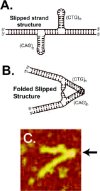
S-DNA forms in regions with direct repeats, where out-of-register base pairing creates looped-out regions. This structure is implicated in triplet repeat expansion diseases and frameshift mutagenesis.
Formation: Occurs in GC-rich repeats and is stabilized by hairpin-forming sequences.
Biological Role: Associated with genetic diseases and mutagenesis.
DNA Unwinding Elements (DUEs)
DUEs are AT-rich sequences that unwind under superhelical tension, forming unpaired regions. They are commonly found at replication origins and matrix attachment regions.
Biological Role: Essential for the initiation of DNA replication in prokaryotes and eukaryotes.
Disease Association: Expansion of DUEs can lead to disorders such as spinocerebellar ataxia type 10.
Biological Roles of Alternative DNA Structures
Modulation of Supercoiling
Alternative DNA structures can relax superhelical tension, affecting transcription, replication, and recombination. They are often found in regulatory regions and can modulate gene expression by altering DNA topology.
Nucleosome Exclusion
Formation of cruciforms, Z-DNA, and triplex DNA is mutually exclusive with nucleosome formation, exposing DNA for protein binding and facilitating transcription and replication.
Positioning and Molecular Switches
Alternative structures can position distant DNA elements for recombination or enhancer-promoter interactions. Cruciform transitions may serve as molecular switches for chromosome structure.
Roles in Transcription, Replication, and Recombination
Transcription: Alternative structures influence transcription initiation and factor binding.
Replication: Can block polymerases or serve as recognition elements for replication proteins.
Recombination: Facilitate strand exchange and homologous recombination.
Conclusion
Alternative DNA conformations are functionally important in both prokaryotic and eukaryotic cells. Their formation is regulated by sequence, environmental conditions, protein binding, and superhelical tension, and they play critical roles in replication, gene expression, recombination, and mutagenesis.
