 Indietro
Bacterial and Viral Genetic Systems: Mechanisms and Mapping
Guida di studio - Note intelligenti
 Appunti personalizzati basati sui tuoi materiali, ampliati con definizioni chiave, esempi e contesto.
Chapter 9: Bacterial and Viral Genetic Systems
Overview of Bacterial and Viral Genetics
Bacteria and viruses serve as essential model organisms for genetic studies due to their simple genomes and rapid reproduction. This chapter explores the mechanisms of gene transfer in bacteria, the use of bacteriophages in genetic analysis, and modern genetic tools such as CRISPR-Cas systems.
Genetic Analysis of Bacteria: Approaches and Methods
Types of Bacterial Strains and Growth Media
Prototrophic: Wild-type bacteria capable of synthesizing all essential compounds from minimal medium.
Auxotrophic: Mutant bacteria that require additional nutrients due to loss of biosynthetic ability for specific compounds.
Minimal Medium: Contains only a carbon source and salts; only prototrophs can grow.
Complete Medium: Contains all nutrients required by bacteria, supporting both prototrophs and auxotrophs.
Defined Medium: Lacks one or a few specific nutrients, used to test for auxotrophy.
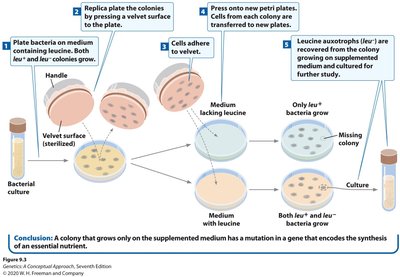
Example: An auxotrophic mutant with a defect in the leucine biosynthesis pathway will only grow if leucine is supplied in the medium.
Colony Formation and Replica Plating
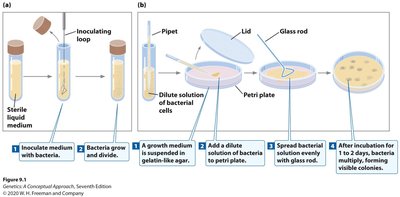
Bacteria can be grown in liquid cultures or on solid media. A single bacterium on a petri dish divides to form a genetically identical colony. Replica plating is a technique used to identify auxotrophic mutants by transferring colonies to media lacking specific nutrients.
Gene Transfer Mechanisms in Bacteria
Conjugation
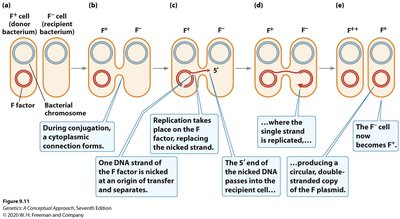
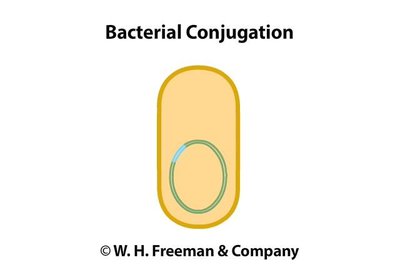
Conjugation is the direct transfer of DNA from one bacterium (donor) to another (recipient) via cell-to-cell contact. The F (fertility) factor is a plasmid that enables this process.
F+ cells: Contain the F plasmid and can initiate conjugation.
F- cells: Lack the F plasmid and act as recipients.
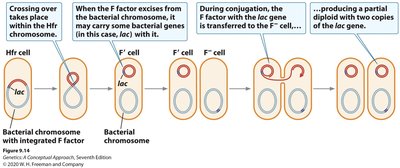
Hfr cells: Have the F factor integrated into their chromosome, allowing high-frequency transfer of chromosomal genes.
F' cells: Formed when the F factor excises from the chromosome, carrying some chromosomal genes with it.
Partial Diploids (Merozygotes)
When an F' plasmid is transferred to an F- cell, the recipient becomes a partial diploid for the genes carried on the plasmid.
Mapping Bacterial Genes by Interrupted Mating
Interrupted mating experiments use Hfr strains to map gene order on the bacterial chromosome. By stopping conjugation at various time points, the sequence in which genes are transferred can be determined, reflecting their relative positions.
Transformation
Transformation involves the uptake of free DNA from the environment by a competent bacterium. The incoming DNA can recombine with the recipient's chromosome, resulting in genetic change.
Competent cells: Cells capable of taking up DNA.
Transformant: A cell that has incorporated foreign DNA.
Cotransformation occurs when two or more genes are transferred together. The frequency of cotransformation is higher for genes that are physically close on the chromosome, allowing gene mapping based on cotransformation frequencies.
Pair of Genes | Cotransformation |
|---|---|
a+ and b+ | no |
a+ and c+ | no |
a+ and d+ | yes |
a+ and e+ | yes |
b+ and c+ | yes |
b+ and d+ | no |
b+ and e+ | yes |
c+ and d+ | no |
c+ and e+ | yes |
d+ and e+ | no |
Example: If genes M and S cotransform at a higher frequency than M and F, S is likely located between M and F on the chromosome.
Transduction
Transduction is the transfer of bacterial genes by bacteriophages (viruses that infect bacteria). There are two main types:
Generalized transduction: Random bacterial DNA fragments are packaged into phage particles and transferred to new hosts.
Specialized transduction: Only specific bacterial genes near the prophage integration site are transferred.
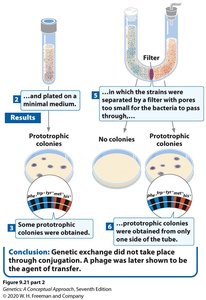
Transduction does not require direct contact between donor and recipient cells, as demonstrated by experiments using filters that block cell passage but allow phage transfer.
Bacteriophage Genetics
Bacteriophage Life Cycles
Lytic cycle: Phage replicates and lyses the host cell, releasing new phage particles.
Lysogenic cycle: Phage DNA integrates into the host genome as a prophage and can later re-enter the lytic cycle.
Plaques are clear zones on a bacterial lawn caused by phage-induced cell lysis.
Gene Mapping in Phages
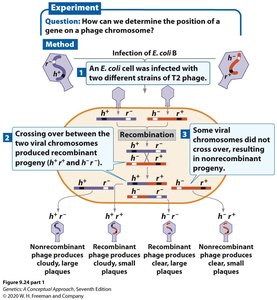
Phage gene mapping is performed by co-infecting bacteria with different phage strains and analyzing recombinant progeny. The frequency of recombination between phage genes reflects their physical distance on the phage chromosome.
CRISPR-Cas Immunity in Bacteria
Mechanism of CRISPR-Cas
CRISPR-Cas is an adaptive immune system in bacteria that provides resistance to foreign genetic elements such as phages. It operates in three steps:
Adaptation: Integration of foreign DNA fragments into the CRISPR array.
Expression: Transcription and processing of the CRISPR array into crRNAs.
Interference: crRNAs guide Cas proteins to complementary DNA sequences, which are then cleaved.
This system has been adapted as a powerful tool for genome editing in research and biotechnology.
Summary Table: Results of Conjugation Between Cells with Different F Factors
Conjugating Cells | Cell Types Present after Conjugation |
|---|---|
F+ × F− | Two F+ cells (F− cell becomes F+) |
Hfr × F− | One Hfr cell and one F− cell (no change)* |
F' × F− | Two F' cells (F− cell becomes F') |
*Rarely, the F− cell becomes F+ in an Hfr × F− conjugation if the entire chromosome is transferred during conjugation.
Key Concepts and Applications
Bacterial gene transfer occurs via conjugation, transformation, and transduction, each with unique mechanisms and mapping applications.
Gene mapping in bacteria and phages relies on recombination frequencies and cotransformation/cotransduction data.
CRISPR-Cas systems provide adaptive immunity in bacteria and are foundational to modern genome editing technologies.
