 Indietro
Chromosome Mutations: Variation in Chromosome Number and Arrangement
Guida di studio - Note intelligenti
 Appunti personalizzati basati sui tuoi materiali, ampliati con definizioni chiave, esempi e contesto.
Chromosome Mutations: Variation in Chromosome Number and Arrangement
Introduction
Chromosome mutations, also known as chromosomal aberrations, refer to changes in chromosome number or structure. These mutations can have significant effects on an organism's phenotype and viability. This chapter explores the types, origins, and consequences of chromosomal mutations, focusing on aneuploidy, polyploidy, and structural rearrangements.
Variation in Chromosome Number
Aneuploidy vs. Euploidy
Aneuploidy is the condition in which an organism gains or loses one or more chromosomes but not a complete set. In contrast, euploidy refers to the presence of one or more complete sets of chromosomes. These variations can arise due to errors during cell division, particularly nondisjunction.
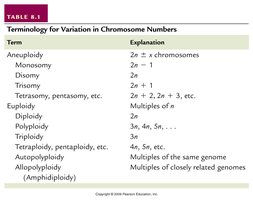
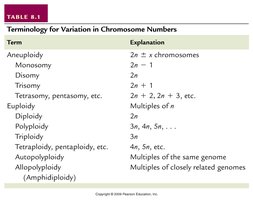
Aneuploidy: 2n ± x chromosomes (e.g., monosomy, trisomy)
Euploidy: Multiples of the haploid set (e.g., diploid 2n, triploid 3n, tetraploid 4n)
Term | Explanation |
|---|---|
Aneuploidy | 2n ± x chromosomes |
Monosomy | 2n – 1 |
Disomy | 2n |
Trisomy | 2n + 1 |
Tetrasomy, pentasomy, etc. | 2n + 2, 2n + 3, etc. |
Euploidy | Multiples of n |
Diploidy | 2n |
Triploidy | 3n |
Tetraploidy, pentaploidy, etc. | 4n, 5n, etc. |
Autopolyploidy | Multiples of the same genome |
Allopolyploidy | Multiples of closely related genomes |
Nondisjunction
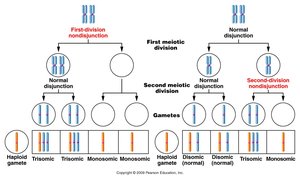
Nondisjunction is the failure of homologous chromosomes or sister chromatids to separate properly during meiosis I or II. This leads to gametes with abnormal chromosome numbers, which can result in aneuploid offspring.
First-division nondisjunction: Both homologs migrate to the same pole during meiosis I.
Second-division nondisjunction: Sister chromatids fail to separate during meiosis II.
Types of Aneuploidy
Monosomy (2n – 1): Loss of a single chromosome. Usually lethal in animals due to unmasking of recessive lethal mutations and haploinsufficiency. Example: Turner syndrome (XO) in humans.
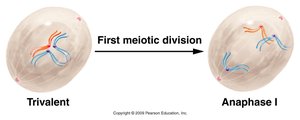
Trisomy (2n + 1): Gain of a single chromosome. Can result in viable offspring with distinct phenotypes, though most autosomal trisomies are lethal.
Trisomy Disorders
Some trisomies are compatible with life and result in recognizable syndromes:
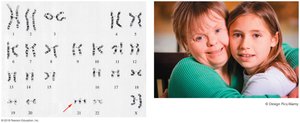
Down syndrome (Trisomy 21): Most common viable autosomal trisomy. Caused by nondisjunction, usually in the maternal gamete. Incidence increases with maternal age.
Patau syndrome (Trisomy 13) and Edwards syndrome (Trisomy 18): Both are associated with severe developmental abnormalities and high mortality.
Polyploidy
Definition and Types
Polyploidy refers to the presence of more than two complete sets of chromosomes. It is common in plants and rare in animals. Polyploids are classified based on the number of chromosome sets:
Triploid (3n)
Tetraploid (4n)
Pentaploid (5n)
Origins of Polyploidy
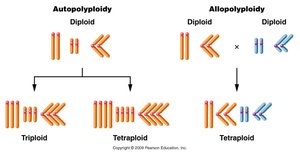
Polyploidy can arise through two main mechanisms:
Autopolyploidy: Chromosome sets are derived from a single species, often due to errors in mitosis or meiosis.
Allopolyploidy: Chromosome sets originate from different species, typically following hybridization and chromosome doubling.
Polyploidy in Plants
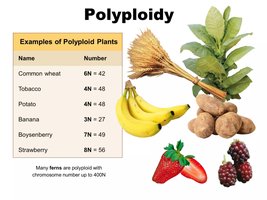
Polyploidy is especially prevalent in plants and can result in increased size, vigor, and adaptation. Many important crops are polyploid, such as wheat, tobacco, and strawberries.
Autopolyploidy and Allopolyploidy Mechanisms
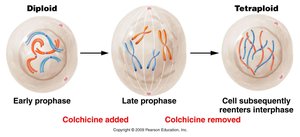
Autopolyploidy: May result from chromosome duplication without cell division (e.g., colchicine treatment).
Allopolyploidy: Hybridization between species followed by chromosome doubling can produce fertile amphidiploids.
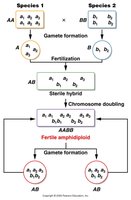
Allopolyploidy Example: Cotton
Modern cultivated cotton is an amphidiploid formed by hybridization between Old World and American cotton species, followed by chromosome doubling. This process results in a fertile plant with chromosome sets from both parental species.

Chromosomal Rearrangements
Types of Rearrangements
Chromosomal rearrangements involve changes in the structure of chromosomes and include deletions, duplications, inversions, and translocations.
Deletions: Loss of a chromosome segment.
Duplications: Repetition of a chromosome segment.
Inversions: Reversal of a chromosome segment.
Translocations: Movement of a chromosome segment to a new location.
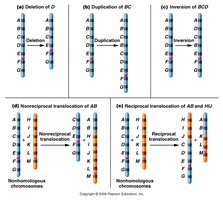
Deletions
A deletion occurs when a chromosome breaks and a segment is lost. Deletions can be terminal (end of chromosome) or intercalary (internal segment). Deletions can cause genetic disorders if essential genes are lost.
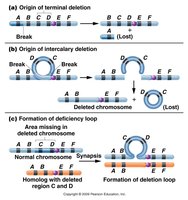
During synapsis, the normal homolog forms a deletion (compensation) loop to align with the deleted chromosome.
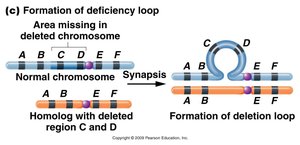
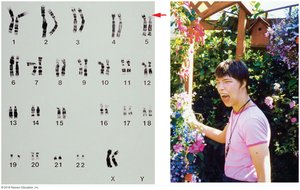
Example: Cri Du Chat Syndrome
Cri Du Chat syndrome is caused by a deletion of the terminal part of chromosome 5. It results in developmental abnormalities and a distinctive cry in infants. The deleted region includes the CTNND2 gene, which is haploinsufficient.
Duplications
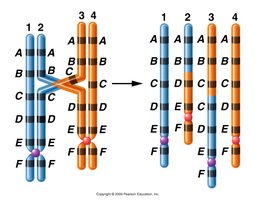
A duplication is a repeated segment of genetic material. Duplications often arise from unequal crossing over during meiosis or replication errors. They can provide raw material for evolutionary innovation but may also disrupt gene function.
Inversions
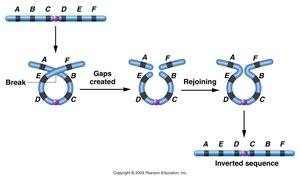
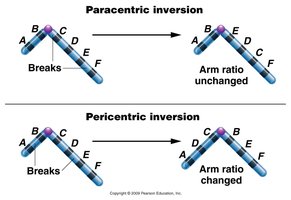
An inversion involves the reversal of a chromosome segment. Inversions require two breaks and reinsertion of the inverted segment. They are classified as:
Paracentric inversion: Does not include the centromere; arm lengths unchanged.
Pericentric inversion: Includes the centromere; arm lengths changed.
Translocations
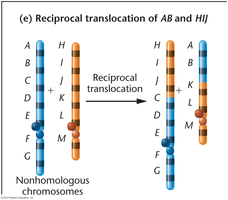
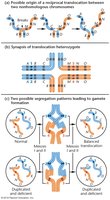
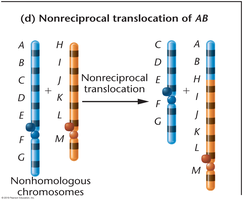
A translocation is the movement of a chromosome segment to a new location. Types include:
Reciprocal translocation: Exchange of segments between two nonhomologous chromosomes.
Nonreciprocal translocation: Segment moves to a new location without reciprocal exchange.
Summary Table: Chromosome Number Variation
Term | Definition |
|---|---|
Monosomy | Loss of a single chromosome (2n – 1) |
Trisomy | Gain of a single chromosome (2n + 1) |
Polyploidy | More than two haploid sets of chromosomes |
Deletion | Missing region of a chromosome |
Duplication | Repeated segment of a chromosome |
Inversion | Rearrangement of linear gene sequence |
Translocation | Movement of chromosomal segment to a new location |
Key Equations
Chi-Squared Test:
Binomial Expansion Theorem:
