 Indietro
DNA Replication: Mechanisms, Enzymes, and Regulation
Guida di studio - Note intelligenti
 Appunti personalizzati basati sui tuoi materiali, ampliati con definizioni chiave, esempi e contesto.
DNA Replication: Overview and Biological Importance
Introduction to DNA Replication
DNA replication is a fundamental process that ensures the accurate transmission of genetic information from one generation to the next. It is essential for cell division, growth, repair, and development in all living organisms. Before a cell divides, its DNA must be duplicated so that each daughter cell receives an identical set of genetic instructions.
Genetic continuity: Maintains the integrity of hereditary information.
Growth and repair: Provides new cells for tissue growth and repair.
Cell division: Ensures each new cell receives a complete genome during mitosis or meiosis.
Models of DNA Replication
Semiconservative, Conservative, and Dispersive Replication
Three models were proposed to explain how DNA replicates:
Conservative replication: The original DNA molecule remains intact, and a completely new molecule is synthesized.
Semiconservative replication: Each daughter DNA molecule consists of one parental (original) strand and one newly synthesized strand.
Dispersive replication: Both daughter molecules contain interspersed segments of parental and newly synthesized DNA.
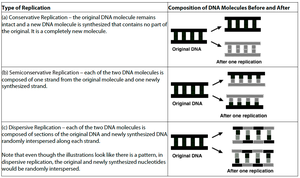
Semiconservative replication is the correct model, as demonstrated by the Meselson-Stahl experiment.
Experimental Evidence: The Meselson-Stahl Experiment
Demonstrating Semiconservative Replication
The Meselson-Stahl experiment provided definitive evidence for the semiconservative model. Escherichia coli cells were grown in a medium containing heavy nitrogen (15N), then shifted to a medium with light nitrogen (14N). DNA was extracted at various generations and analyzed using density gradient centrifugation.
After one generation in 14N, DNA had an intermediate density, ruling out the conservative model.
After two generations, both intermediate and light DNA were observed, supporting semiconservative replication.
Dispersive replication would produce only intermediate DNA, even after multiple generations.
Key Steps and Enzymes in DNA Replication
Initiation: Origins of Replication and Replication Forks
DNA replication begins at specific sequences called origins of replication (ORI). At the ORI, the DNA double helix is unwound, forming a replication fork. Replication is typically bidirectional, with two forks moving away from the origin.
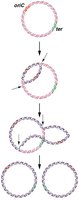
The replicon is the length of DNA replicated from a single origin.
Unwinding the DNA Helix
Several proteins and enzymes are required to unwind and stabilize the DNA helix:
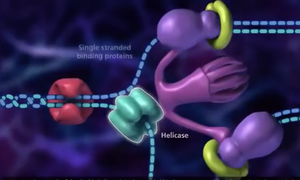
DnaA: Initiator protein that binds to the ORI, causing the DNA to open.
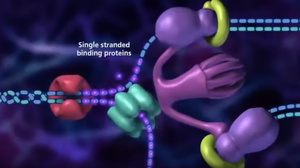
DNA helicase (DnaB): Unwinds the DNA helix using energy from ATP hydrolysis.
Single-stranded binding proteins (SSBPs): Stabilize the unwound single-stranded DNA.
DNA gyrase (topoisomerase): Relieves supercoiling tension ahead of the replication fork by making transient cuts in the DNA.
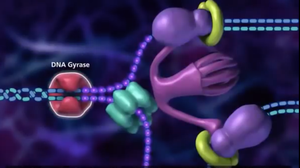
Elongation: Synthesis of New DNA Strands
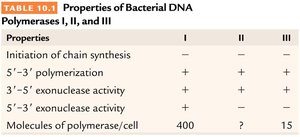
DNA polymerases catalyze the synthesis of new DNA strands. In bacteria, five DNA polymerases are involved, with DNA polymerase III being the main enzyme for chromosomal replication.
Primase: Synthesizes short RNA primers to provide free 3'-OH groups for DNA polymerase to begin synthesis.
DNA polymerase III: Extends the new DNA strand from the RNA primer in the 5' to 3' direction.
DNA polymerase I: Removes RNA primers and fills in the gaps with DNA.
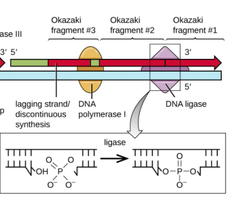
DNA ligase: Seals nicks between Okazaki fragments on the lagging strand by forming phosphodiester bonds.
Properties of Bacterial DNA Polymerases
Properties | I | II | III |
|---|---|---|---|
Initiation of chain synthesis | – | – | – |
5'–3' polymerization | + | + | + |
3'–5' exonuclease activity | + | + | + |
5'–3' exonuclease activity | + | – | – |
Molecules of polymerase/cell | 400 | ? | 15 |
DNA Polymerase III Holoenzyme Structure
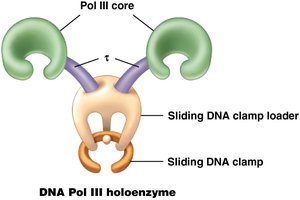
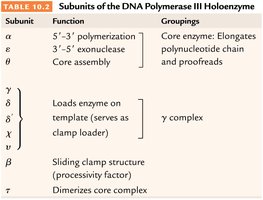
The DNA polymerase III holoenzyme is a complex of multiple subunits, each with specialized functions:
Subunit | Function | Groupings |
|---|---|---|
α | 5'–3' polymerization | Core enzyme |
ε | 3'–5' exonuclease | Core enzyme |
θ | Core assembly | Core enzyme |
γ, δ, δ', χ, ψ | Loads enzyme on template (clamp loader) | γ complex |
β | Sliding clamp structure (processivity factor) | |
τ | Dimerizes core complex |
Leading and Lagging Strand Synthesis
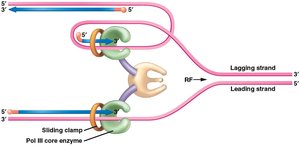
Because DNA polymerases can only synthesize DNA in the 5' to 3' direction, replication is continuous on the leading strand and discontinuous on the lagging strand. The lagging strand is synthesized as short fragments called Okazaki fragments, each initiated by an RNA primer.
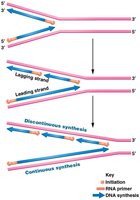
Both strands are synthesized concurrently at the replication fork, with the lagging strand looping to allow simultaneous synthesis.
Termination of DNA Replication
Replication ends when two replication forks meet. In bacteria, this involves fork fusion, disassembly of the replication machinery, and decatenation (separation) of the daughter DNA molecules.
Genetic Regulation and Mutation in DNA Replication
Genes Involved in DNA Replication
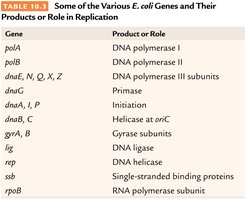
Multiple genes encode the proteins and enzymes required for DNA replication. Mutations in these genes can impair replication and may be lethal or cause disease.
Gene | Product or Role |
|---|---|
polA | DNA polymerase I |
polB | DNA polymerase II |
dnaE, N, Q, X, Z | DNA polymerase III subunits |
dnaG | Primase |
dnaA, I, P | Initiation |
dnaB, C | Helicase at oriC |
gyrA, B | Gyrase subunits |
lig | DNA ligase |
rep | DNA helicase |
ssb | Single-stranded binding proteins |
rpoB | RNA polymerase subunit |
Mutations Affecting DNA Replication
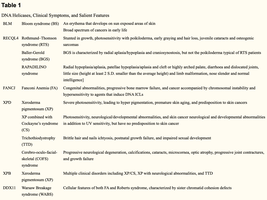
Spontaneous mutations in replication genes can lead to defective DNA synthesis, increased mutation rates, or diseases such as Bloom syndrome. For example, mutations in the DNA helicase gene can cause growth defects, immune deficiency, and increased cancer risk.
DNA Helicase | Clinical Syndrome | Salient Features |
|---|---|---|
BLM | Bloom syndrome | Short stature, rash, immune deficiency, cancer risk |
RECQL4 | Rothmund-Thomson syndrome | Growth retardation, poikiloderma, cancer risk |
WRN | Werner syndrome | Premature aging, cancer risk |
FANCM | Fanconi anemia | Bone marrow failure, cancer risk |
XPD | Xeroderma pigmentosum | UV sensitivity, skin cancer risk |
Eukaryotic DNA Replication: Complexity and Regulation
Key Differences from Prokaryotic Replication
Eukaryotic DNA replication shares many features with prokaryotic replication but is more complex due to:
Greater amount of DNA
Linear chromosomes
DNA packaged with histones into nucleosomes (chromatin)
Multiple origins of replication per chromosome
Replication initiates at multiple origins (e.g., 250–400 in yeast, 40,000–80,000 in humans) to ensure rapid duplication of large genomes.
Multiple Eukaryotic DNA Polymerases
Key eukaryotic DNA polymerases include:
Polymerase α: Initiates DNA synthesis by synthesizing RNA primers and a short stretch of DNA.
Polymerase δ and ε: Take over for elongation of the leading and lagging strands.
Polymerase switching occurs after primer synthesis, with δ and ε replacing α for processive DNA synthesis.
Chromatin Remodeling During Replication
In eukaryotes, DNA is wrapped around histone proteins to form nucleosomes. During replication, chromatin must be disassembled and reassembled by chromatin remodelers and assembly factors to allow access to the DNA template.
Telomeres and the End-Replication Problem
The ends of linear chromosomes, called telomeres, pose a challenge during replication because conventional DNA polymerases cannot fully replicate the 3' ends. Telomeres consist of repetitive sequences that protect chromosome ends from degradation.
Telomerase is a ribonucleoprotein enzyme that extends telomeres by adding repetitive sequences, using its own RNA as a template. This prevents the progressive shortening of chromosomes with each cell division.
Telomerase activity is high in germ cells and cancer cells, but low in most somatic cells.
Telomere shortening is associated with cellular aging; sustained telomerase activity is linked to cellular immortality in cancer.
Summary of DNA Replication
DNA replication is semiconservative, as shown by the Meselson-Stahl experiment.
Key steps include helix unwinding, stabilization, primer synthesis, DNA synthesis, primer removal, fragment joining, and proofreading.
Eukaryotic replication is more complex due to chromatin structure and multiple origins.
Telomere replication requires telomerase to prevent loss of genetic information.
