 Indietro
DNA Structure, Function, and Genetic Material: Study Notes for Genetics (BIOL 260)
Guida di studio - Note intelligenti
 Appunti personalizzati basati sui tuoi materiali, ampliati con definizioni chiave, esempi e contesto.
Course Introduction to Genetics
Overview of Genetics
Genetics is the scientific study of heredity and variation in living organisms. It explores how traits are passed from parents to offspring and the molecular mechanisms underlying these processes. The field integrates cellular, molecular, and evolutionary perspectives to understand the role of genes in development, health, and disease.
Heredity: The biological process by which parents transmit genes to their offspring, influencing physical, psychological, and emotional traits.
Gene: A segment of DNA that encodes information for the synthesis of proteins or functional RNA molecules.
Genetic Mechanisms: Include DNA replication, gene expression, mutation, and recombination.
Applications: Genetics is foundational in biotechnology, medicine, agriculture, and evolutionary studies.
Course Outcomes: Students will gain a comprehensive understanding of the cellular and molecular basis of heredity, genetic mechanisms in evolution, and the application of genetic technologies in various industries.
Fundamental Concepts in Genetics
Cellular Organization of Genetic Material
Genetic information is organized within cells in a hierarchical manner, from DNA to genes, chromosomes, and the nucleus.
Cell: The basic unit of life containing the nucleus where genetic material is stored.
Nucleus: Membrane-bound organelle housing chromosomes.
Chromosome: A structure composed of DNA and proteins that carries genetic information.
Gene: Functional unit of heredity located on chromosomes.
DNA (Deoxyribonucleic Acid): The molecule that stores genetic information.
Base Pair: A pair of complementary nitrogenous bases (A-T, G-C) in a DNA molecule.
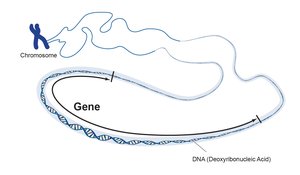
DNA Structure and Analysis
Structural and Functional Characteristics of DNA
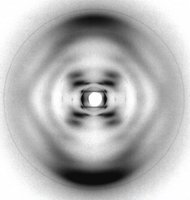
DNA is a double-helical molecule composed of nucleotides, each consisting of a phosphate group, a deoxyribose sugar, and a nitrogenous base. The structure of DNA is essential for its function as the genetic material in almost all living organisms.
Nucleotide: The basic building block of DNA, consisting of a phosphate group, deoxyribose sugar, and a nitrogenous base.
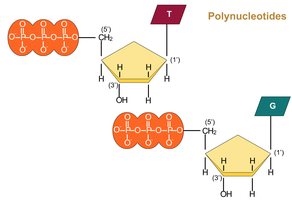
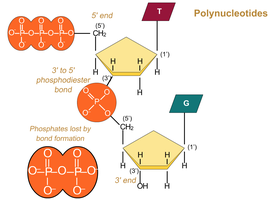
Phosphodiester Bond: Covalent bond linking nucleotides in a DNA strand, formed between the 3'-OH group of one sugar and the 5'-phosphate of the next.
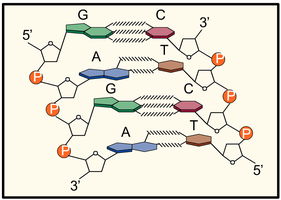
Antiparallel Double Helix: DNA strands run in opposite directions (5' to 3' and 3' to 5'), stabilized by hydrogen bonds between complementary bases.
Chargaff’s Rules: The amount of adenine (A) equals thymine (T), and guanine (G) equals cytosine (C).
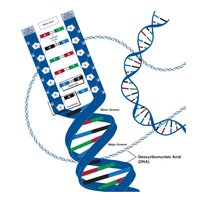
Nitrogenous Bases and DNA Backbone
DNA contains four nitrogenous bases: adenine (A), thymine (T), guanine (G), and cytosine (C). The sugar-phosphate backbone provides structural support.
Pyrimidines: Cytosine (C) and Thymine (T) – single-ring structures.
Purines: Adenine (A) and Guanine (G) – double-ring structures.
Base Pairing: A pairs with T via two hydrogen bonds; G pairs with C via three hydrogen bonds.
Polynucleotide Formation and DNA Polarity
DNA polymerase catalyzes the formation of polynucleotides by adding nucleotides to the 3'-OH end, resulting in a strand synthesized in the 5' to 3' direction.
Polymerization: New DNA strands are always synthesized in the 5’ to 3’ direction.
Phosphodiester Bond: Connects the 3’ carbon of one sugar to the 5’ phosphate of the next.
Antiparallel Orientation: One strand runs 5’ to 3’, the other 3’ to 5’.
DNA vs. RNA
RNA is chemically similar to DNA but differs in several key aspects. RNA contains ribose sugar instead of deoxyribose and uracil (U) instead of thymine (T). Most RNA molecules are single-stranded.
Messenger RNA (mRNA): Carries genetic information from DNA to ribosomes for protein synthesis.
Ribosomal RNA (rRNA): Structural component of ribosomes.
Transfer RNA (tRNA): Brings amino acids to ribosomes during translation.
Chargaff’s Rules and Base Pairing Calculations
Chargaff’s Rules
Chargaff’s rules state that in double-stranded DNA, the amount of adenine equals thymine, and the amount of guanine equals cytosine. These relationships are crucial for understanding DNA structure and for solving base composition problems.
Example Calculation: If a DNA molecule contains 30% adenine, it must also contain 30% thymine. The remaining 40% is divided equally between guanine and cytosine (20% each).
Base Pairing: The sequence of one DNA strand determines the sequence of its complementary strand.
Genetic Information and Its Applications
DNA Sequence Information
The sequence of nucleotides in DNA encodes genetic information, which determines the structure and function of proteins. DNA analysis allows for the identification of genes, regulatory regions, mutations, and genetic variation.
Gene Identification: Locating genes and regulatory elements within the genome.
Protein Synthesis: The nucleotide sequence determines the amino acid sequence of proteins.
Mutation Detection: Identifying sequence changes that may affect gene function or phenotype.
Evolutionary Studies: Comparing DNA sequences among organisms to study evolutionary relationships.
Assignments and Practice Questions
Assignment I: Nucleotide Structure and DNA Models
Identify and label the chemical components of a nucleotide.
Describe the differences between nucleoside and nucleotide, and between ribose and deoxyribose.
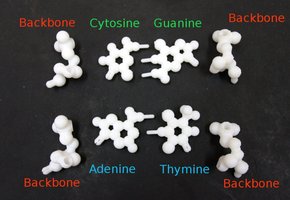
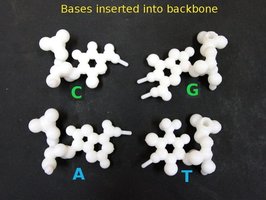
Demonstrate the structure of adenosine (nucleoside), guanine diphosphate, and thymidine triphosphate using molecular models.
Show the chemical bonds linking cytosine triphosphate and guanosine triphosphate to form a dimer.
Explain the difference between ATP and dATP using models.
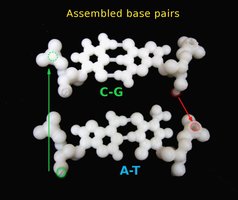
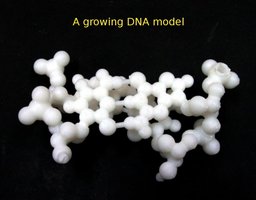
Assignment II: DNA Double Helix Model
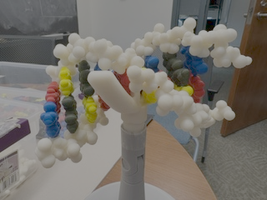
Assemble a 3D-printed DNA double helix model with classmates.
Each student must contribute at least two nitrogenous pairs and four phosphate backbones.
Identify DNA sequences within the assembled model.
Practice Questions
Which type of chemical bond links nucleotides together in a double helical DNA strand?
What are the two types of nitrogenous bases found in DNA?
What are the four nitrogenous bases found in DNA?
Which nitrogenous base pairs with cytosine in a DNA molecule?
What is the orientation of the two strands in a DNA double helix?
During DNA replication, in which direction are new DNA strands synthesized?
What is the chemical structure of the sugar molecule in DNA?
How do the phosphate groups contribute to the structure of the DNA molecule?
Briefly explain what it means for DNA strands to be antiparallel.
If one strand of DNA has the sequence 5’-ACGTT-3’, what is the sequence of the complementary strand?
Summary Table: DNA and RNA Comparison
Feature | DNA | RNA |
|---|---|---|
Sugar | Deoxyribose | Ribose |
Strands | Double-stranded | Single-stranded (usually) |
Nitrogenous Bases | A, T, G, C | A, U, G, C |
Base Pairing | A-T, G-C | A-U, G-C |
Function | Genetic information storage | Gene expression, protein synthesis |
