 Indietro
Extensions and Modifications of Mendelian Genetics: Study Notes
Guida di studio - Note intelligenti
 Appunti personalizzati basati sui tuoi materiali, ampliati con definizioni chiave, esempi e contesto.
Monohybrid and Dihybrid Crosses: Mendelian Ratios
Understanding Mendel's Experimental Approach
Mendel's experiments with pea plants established the foundational principles of inheritance. By performing monohybrid and dihybrid crosses, he revealed predictable ratios for the transmission of traits.
Monohybrid Cross: Involves one gene; F2 ratio is 1:2:1 for genotypes and 3:1 for phenotypes.
Dihybrid Cross: Involves two genes; F2 ratio is 9:3:3:1 for phenotypes, demonstrating independent assortment.
Trihybrid Cross: Extends Mendel's principles to three genes, showing that inheritance patterns apply to multiple traits.
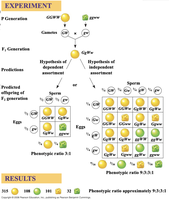
Mathematical Rules in Genetics
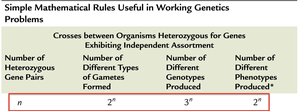
Simple mathematical rules help predict the outcomes of genetic crosses involving independent assortment.
Number of Heterozygous Gene Pairs (n) | Number of Different Types of Gametes Formed | Number of Different Genotypes Produced | Number of Different Phenotypes Produced |
|---|---|---|---|
n |
Probability and Pedigree Analysis
Laws of Probability in Genetics
Probability laws are essential for predicting genetic outcomes:
Product Rule (Multiplication): Used for simultaneous independent events.
Sum Rule (Addition): Used when considering mutually exclusive events.
Pedigree Analysis
Pedigrees are diagrams that reveal inheritance patterns of human traits. They are crucial for tracking traits through generations and for identifying modes of inheritance (dominant, recessive, X-linked, etc.).
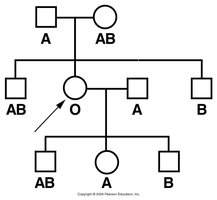
Extensions to Mendelian Genetics
Alleles and Phenotypes
Understanding alleles is fundamental to genetics. An allele is an alternate form of a gene. The most common allele in a population is called the wild-type allele, which is often, but not always, dominant. Mutant alleles arise from mutations and may result in altered gene products.
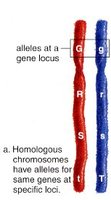
Types of Mutant Alleles
Loss-of-function allele: Reduces or eliminates gene function.
Null allele: Complete loss of function.
Gain-of-function allele: Increases gene activity or confers a new function.
Neutral mutation: No effect on phenotype or function.
Symbols for Alleles
Dominant alleles: Italic uppercase letter (e.g., D for dominant, d for recessive).
Recessive alleles: Italic lowercase letter or with a + superscript for wild-type (e.g., Wr+).
No dominance: Use uppercase letters with superscripts (e.g., R1, R2).
Non-Mendelian Inheritance Patterns
Incomplete Dominance
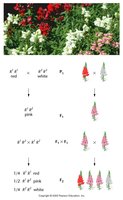
Incomplete dominance occurs when the heterozygote displays an intermediate phenotype between the two homozygotes. Neither allele is completely dominant.
Example: In snapdragons, crossing red and white flowers yields pink offspring.
Genotype ratio equals phenotype ratio (1:2:1).
Codominance
Codominance is the joint expression of both alleles in a heterozygote, resulting in both gene products being detectable.
Example: MN blood group in humans, where both M and N antigens are expressed in heterozygotes.
Multiple Alleles
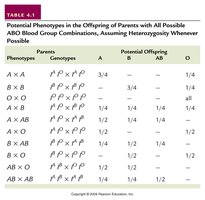
Some genes have more than two alleles in a population. The classic example is the ABO blood group system in humans, controlled by three alleles: IA, IB, and i.
Phenotypes: A, B, AB, and O blood types.
Inheritance patterns can be predicted by examining parental genotypes.
Phenotypes | Parents Genotypes | Potential Offspring A | B | AB | O |
|---|---|---|---|---|---|
A × A | IAIA × IAIA | 3/4 | 0 | 0 | 1/4 |
A × B | IAIA × IBIB | 1/4 | 1/4 | 1/2 | 0 |
O × O | ii × ii | 0 | 0 | 0 | 1 |
Bombay Phenotype and Epistasis
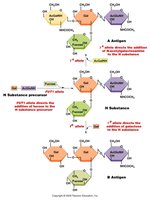
The Bombay phenotype is an example of epistasis, where a mutation in the FUT1 gene prevents the synthesis of the H substance, masking the expression of A and B antigens. Individuals with the Bombay phenotype appear as blood type O, regardless of their ABO genotype.
Gene Interactions and Epistasis
Gene Interactions
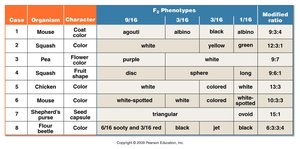
Many phenotypes are influenced by interactions between multiple genes. Epistasis occurs when one gene masks or modifies the effect of another gene at a different locus.
Recessive epistasis: Homozygous recessive at one locus masks expression at another (e.g., coat color in mice).
Dominant epistasis: Dominant allele at one locus masks expression at another (e.g., fruit color in squash).
Complementary gene action: Both genes must have at least one dominant allele to express a phenotype (e.g., flower color in peas).
Case | Organism | Character | 9/16 | 3/16 | 3/16 | 1/16 | Modified ratio |
|---|---|---|---|---|---|---|---|
1 | Mouse | Coat color | agouti | albino | black | albino | 9:3:4 |
2 | Squash | Color | white | yellow | white | green | 12:3:1 |
Lethal Alleles and Pleiotropy
Lethal Alleles
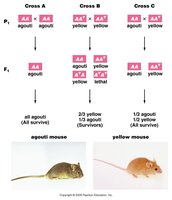
Lethal alleles cause death when present in certain genotypes. Recessive lethal alleles are tolerated in heterozygotes but lethal in homozygotes. Dominant lethal alleles cause death even in heterozygotes, but are rare because they often prevent reproduction.
Example: Yellow coat color in mice is dominant for color but recessive lethal.
Pleiotropy
Pleiotropy occurs when a single gene influences multiple phenotypic traits. Examples include Marfan syndrome (affecting connective tissue, skeleton, eyes, and cardiovascular system) and variagate porphyria (affecting skin and nervous system).
Sex-Linked, Sex-Limited, and Sex-Influenced Inheritance
X-Linked Genes
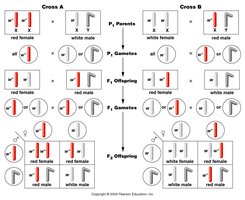
Genes located on the X chromosome exhibit unique inheritance patterns, as males have only one X chromosome. The inheritance of white-eye color in Drosophila is a classic example of X-linkage.
Sex-Limited and Sex-Influenced Traits
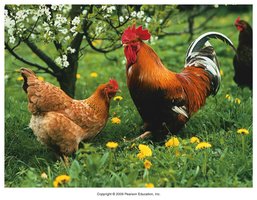
Sex-limited traits are expressed in only one sex, while sex-influenced traits are expressed differently in males and females due to hormonal differences, despite being autosomal.
Example (sex-limited): Cock feathering in chickens occurs only in males.
Example (sex-influenced): Pattern baldness in humans is dominant in males but recessive in females.
Genetic Background, Environment, and Conditional Mutations
Penetrance and Expressivity
Penetrance is the percentage of individuals with a genotype that show the expected phenotype. Expressivity is the degree to which a phenotype is expressed among individuals with the same genotype.
Environmental Effects and Conditional Mutations
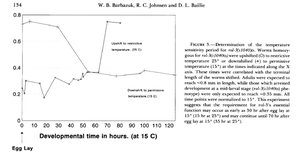
Environmental factors such as temperature can influence gene expression. Conditional mutations (e.g., temperature-sensitive mutations) are only expressed under certain environmental conditions and are useful for studying essential genes.
Genetic Anticipation
Anticipation in Genetic Disorders
Genetic anticipation refers to the phenomenon where certain genetic disorders appear at an earlier age and with increased severity in successive generations. This is often due to the expansion of unstable DNA repeats, as seen in myotonic dystrophy.
Example: The DMPK gene on chromosome 19 contains unstable CTG repeats; longer repeats correlate with earlier onset and increased severity.
Summary Table: Key Genetic Ratios and Interactions
Type of Interaction | Phenotypic Ratio | Example |
|---|---|---|
Simple Mendelian (dihybrid) | 9:3:3:1 | Seed color and shape in peas |
Recessive epistasis | 9:3:4 | Coat color in mice |
Dominant epistasis | 12:3:1 | Fruit color in squash |
Complementary gene action | 9:7 | Flower color in peas |
Additional info: These notes integrate foundational Mendelian genetics with extensions and exceptions, providing a comprehensive overview for exam preparation in a college-level genetics course.
