 Indietro
Extensions and Modifications of Mendel’s Laws: Advanced Patterns of Inheritance
Guida di studio - Note intelligenti
 Appunti personalizzati basati sui tuoi materiali, ampliati con definizioni chiave, esempi e contesto.
Extensions and Modifications of Mendel’s Laws
Introduction
Mendelian genetics provides foundational principles for predicting inheritance patterns, but real-world genetic phenomena often deviate from these simple ratios. This chapter explores the various extensions and modifications to Mendel’s laws, including non-classical dominance relationships, environmental influences, gene interactions, and complex inheritance patterns.
Phenotypic Patterns Diverging from Mendel’s Laws
Causes of Non-Mendelian Phenotypic Ratios
Non-simple Dominance Relationships: Alleles may not exhibit strict dominant/recessive behavior.
Environmental Influence: Phenotype can be affected by external conditions.
Multiple Genes: More than one gene may control a single trait (polygenic inheritance).
Multiple Alleles: More than two alleles may exist for a gene.
Gene Linkage: Genes located on the same chromosome may not assort independently.
Lethal Alleles: Some alleles cause death when present in certain combinations.
Sex Influenced/Limited Traits: Expression depends on the sex of the individual.
Gene Redundancy: Multiple genes may compensate for each other’s function.
Phenotypic Dominance and Its Biochemical Basis
Genetic Definition of Dominance
Dominance occurs when an allele expresses its phenotype in the heterozygous condition. For example, if T is dominant to t in pea plant height:
TT = Tall (6ft)
Tt = Tall (6ft)
tt = Short (2ft)
Thus, T is dominant and t is recessive.
Biochemical Explanation for Dominance
Genes often code for enzymes, which catalyze biochemical reactions. Dominant alleles typically produce functional enzymes, while recessive alleles may result in non-functional enzymes. The substrate is usually limiting, so one functional allele suffices for normal phenotype.
Wild-type: Most common phenotype in nature.
Enzymes: Proteins that catalyze reactions.

Incomplete Dominance and Allelic Series
Incomplete Dominance
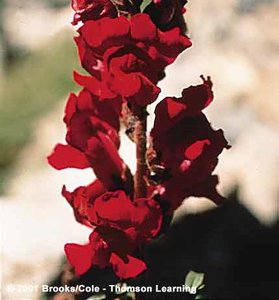
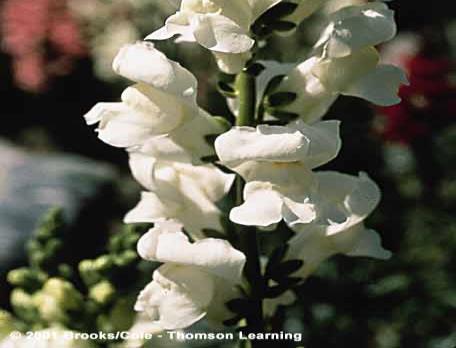
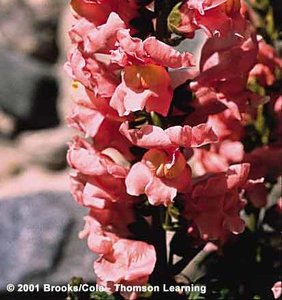
Intermediate phenotypes occur when neither allele is fully dominant. The heterozygote displays a phenotype between the two homozygotes, and the phenotype ratio matches the genotype ratio.
Example: Flower color in snapdragons (Antirrhinum majus)
Cross: CC (red) × cc (white) → Cc (pink)
F2 ratio: 1 red : 2 pink : 1 white
Allelic Series and Partial Function
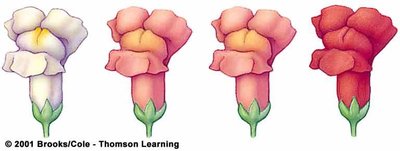
Some genes have multiple alleles with varying degrees of functionality, resulting in a spectrum of phenotypes. The dominance relationship depends on the specific alleles present.
C+: Red (100% activity)
C50: Dark pink (50% activity)
C20: Light pink (20% activity)
C0: White (0% activity)
Environmental Effects on Phenotype
Examples of Environmental Influence
Arctic Fox: Changes coat color seasonally (grayish brown in summer, white in winter).
Phenylketonuria (PKU): Inability to metabolize phenylalanine; symptoms can be prevented by dietary management.
Penetrance and Expressivity
Definitions
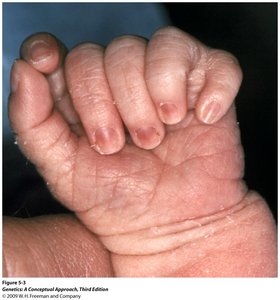
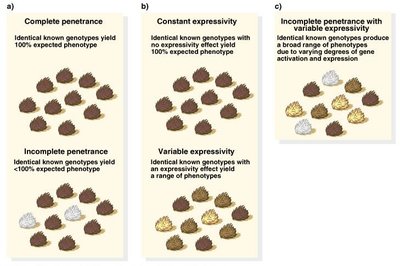
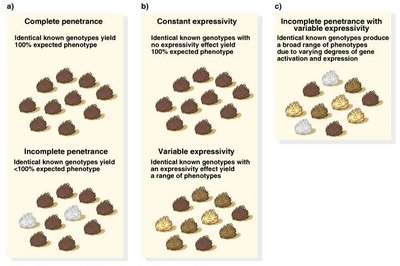
Penetrance: Proportion of individuals with a genotype who express the expected phenotype.
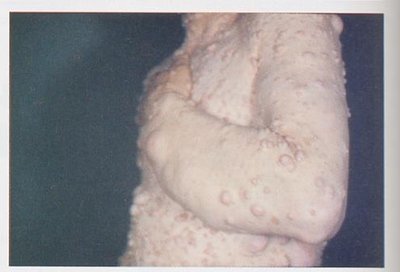
Expressivity: Degree to which a phenotype is expressed among individuals with the same genotype.
Both can skew expected ratios and lead to variable phenotypes.
Blood Group Genetics: Co-dominance and Epistasis
ABO Blood Group System
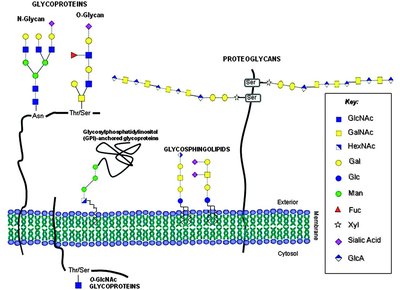
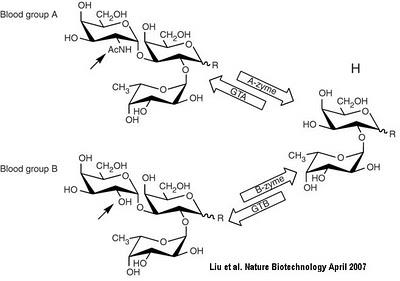
The ABO blood group is a classic example of co-dominance and epistasis. The gene encodes a glycosyltransferase enzyme that modifies antigens on red blood cells.
Type A: Adds N-acetyl galactosamine
Type B: Adds galactose
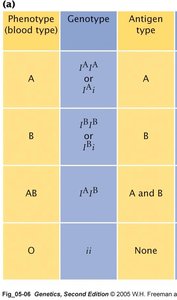
Type AB: Both antigens present (co-dominance)
Type O: No functional enzyme; no antigen
Epistasis in Blood Groups
Epistasis occurs when one gene masks the expression of another. For example, the H locus determines whether ABO antigens are expressed.
Lethal Alleles
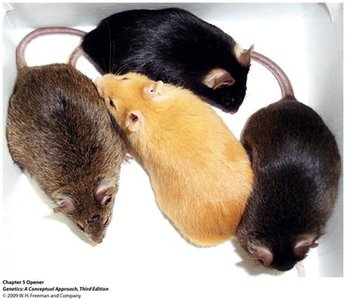
Lucien Cuénot’s Yellow Mice
Lethal alleles can alter expected Mendelian ratios. In yellow mice, the yellow allele is lethal in homozygotes, resulting in a 2:1 ratio of yellow to gray offspring.
Epistasis: Gene Interactions
Types of Epistasis
Recessive Epistasis: Recessive allele at one gene masks another gene’s expression.
Dominant Epistasis: Dominant allele at one gene masks another gene’s expression.
Duplicate Recessive Epistasis: Recessive allele at either of two genes masks the other.
Duplicate Dominant Epistasis: Dominant allele at either of two genes produces the same phenotype.
Epistasis modifies classical Mendelian ratios, often producing 9:7, 12:3:1, or other ratios in dihybrid crosses.
Overdominance and Hybrid Vigor
Overdominance
Overdominance occurs when the heterozygote is more vigorous than either homozygote. Sickle-cell anemia is a classic example, where heterozygotes are resistant to malaria.
HbA: Normal hemoglobin
HbS: Sickle hemoglobin
HbA/HbS: Unaffected, malaria-resistant
HbS/HbS: Sickle cell disease
Three explanations for overdominance:
Disease resistance
Homodimer formation
Variation in functional activity
Sex-Influenced and Sex-Limited Traits
Sex-Influenced Traits
Traits whose expression is influenced by the sex of the individual, such as pattern baldness in humans. The trait is dominant in males but recessive in females.
Genotype | Phenotype in Males | Phenotype in Females |
|---|---|---|
BB | Bald | Bald |
Bb | Bald | Nonbald |
bb | Nonbald | Nonbald |
Sex-Linked Inheritance
Chromosome Theory of Inheritance
Genes reside on chromosomes, and their behavior during meiosis parallels Mendel’s laws. Sex linkage was first demonstrated by Thomas Hunt Morgan in Drosophila melanogaster.
Genes are in pairs, so are chromosomes.
Alleles segregate equally, as do homologous chromosomes.
Different genes act independently, as do different chromosomes.
Sex Linkage in Drosophila
Morgan’s experiments showed that eye color in fruit flies is linked to the X chromosome, leading to different inheritance patterns in males and females.
Reciprocal Crosses and Pedigree Analysis
Reciprocal crosses help distinguish sex-linked inheritance. Pedigree analysis reveals patterns for X-linked dominant, X-linked recessive, and Y-linked traits.
X-linked dominant: Trait can be passed from mother or father to daughters.
X-linked recessive: Sons may have trait if mother is carrier.
Y-linked: Only males affected.
Summary Table: Key Extensions of Mendelian Genetics
Extension | Definition | Example |
|---|---|---|
Incomplete Dominance | Heterozygote shows intermediate phenotype | Snapdragon flower color |
Co-dominance | Both alleles fully expressed | ABO blood group |
Epistasis | One gene masks another | Coat color in Labrador retrievers |
Lethal Alleles | Allele causes death in certain genotypes | Yellow mice |
Overdominance | Heterozygote superior to both homozygotes | Sickle-cell anemia |
Sex-Influenced Traits | Expression depends on sex | Pattern baldness |
Sex-Linked Inheritance | Gene located on sex chromosome | Drosophila eye color |
Additional info: Some explanations and examples were expanded for clarity and completeness, including the biochemical basis of dominance, allelic series, and the molecular mechanisms underlying overdominance.
