 Indietro
Foundations of Genetics: From Classical Principles to Molecular Mechanisms
Guida di studio - Note intelligenti
 Appunti personalizzati basati sui tuoi materiali, ampliati con definizioni chiave, esempi e contesto.
Introduction to Genetics
History and Theories of Inheritance
Genetics is the scientific study of heredity and variation in living organisms. Early applications of genetics included the domestication of plants and animals through selective breeding (artificial selection), where humans bred organisms for desirable phenotypic traits. In contrast, natural selection is an evolutionary process where environmental pressures select for traits over generations.
Epigenesis: The theory that organisms develop from substances in sex cells, not from preformed miniature adults.
Preformation: The belief that sex cells contain a tiny, fully formed human (homunculus) that grows into an adult.
Pangenesis: The idea that particles (gemmules) from all parts of the body collect in reproductive organs and are passed to offspring.
Blending Theory: The outdated view that offspring are a blend of parental traits.
Mendelian Inheritance: Gregor Mendel proposed that discrete particles (now called genes) control heredity, with each organism carrying two copies (alleles) for each trait, one from each parent. One allele may be dominant over the other.
Key Terms:
Homunculus: Hypothetical miniature human in sperm (preformation theory).
Gemmules: Hypothetical particles carrying traits (pangenesis theory).
Modern Genetics: Today, genetics is central to understanding mutation, disease, and improving medicine and agriculture. Single nucleotide polymorphisms (SNPs) are common genetic variations that contribute to individual differences, such as lactose tolerance. Modern genetics relies on biotechnology, gene therapy, proteomics, and bioinformatics.
Chromosomal Fundamentals
Chromosomes are structures containing DNA and proteins. Homologous chromosomes exist in pairs in diploid (2n) organisms, while haploid (n) organisms have one set. The chromosomal theory of inheritance states that genes are located on chromosomes, which are passed through gametes (sperm/egg).
Meiosis: Produces four haploid gametes from a diploid cell.
Mitosis: Produces two identical diploid somatic cells.
Descriptive Genetics
Genotype: The genetic makeup (allele combination) for a trait (e.g., AA, Aa, aa).
Phenotype: Observable traits resulting from genotype and environment (e.g., flower color).
Alleles: Different versions of a gene.
Morphological traits: Affect appearance.
Physiological traits: Affect function.
Behavioral traits: Affect responses to the environment.
Genetics is divided into three main areas:
Transmission genetics: How traits are passed to the next generation.
Molecular genetics: Study of gene activity at the molecular level (e.g., DNA replication, transcription).
Population genetics: Study of gene distribution in populations.
Major Areas of Genetics
Molecular genetics
Classical (Mendelian) genetics
Population genetics
The flow of genetic information: DNA → mRNA → Protein (the central dogma).
Mendel's Laws of Inheritance
Law of Segregation: Each gamete receives only one allele for each gene.
Law of Independent Assortment: Alleles for different genes usually segregate independently.
Dominant vs. Recessive: Dominant alleles show their effect with one copy; recessive alleles require two copies.
Genetic vs. Environmental Determination:
Genetic Determination: Genes define structure and function (e.g., sickle cell anemia, Down’s syndrome).
Environmental Determination: Environment influences traits (e.g., diet affecting heart disease in identical twins).
Developmental Noise: Random variation in development (e.g., fly eye differences).
DNA and Chromosome Structure
DNA as the Genetic Material
DNA (deoxyribonucleic acid) stores and transmits genetic information. Its structure includes:
Phosphate group
Pentose sugar: Deoxyribose (DNA) or ribose (RNA)
Nitrogenous base: Adenine (A), Guanine (G), Cytosine (C), Thymine (T)
Nucleoside: Base + sugar Nucleotide: Base + sugar + phosphate
Purines: Double-ring (A, G)
Pyrimidines: Single-ring (C, T)
Chargaff’s rules: A = T, C = G
DNA strands are held together by:
Phosphodiester bonds: Link nucleotides in a strand
Hydrogen bonds: Link complementary bases (A-T: 2 bonds, C-G: 3 bonds)
DNA forms:
B-DNA: Common, right-handed helix
A-DNA: Rare, shorter right-handed helix
Z-DNA: Rare, left-handed helix
RNA differs from DNA by using ribose, uracil (U) instead of thymine, and being single-stranded. Ribozymes are RNA molecules with catalytic activity. Types of RNA include rRNA (ribosomal), tRNA (transfer), and mRNA (messenger).
Chromatin: Complex of DNA and proteins in chromosomes.
DNA Replication
Models of DNA Replication
Three models were proposed for DNA replication:
Conservative: Parental DNA remains intact; new DNA is entirely new.
Dispersive: DNA strands are mixtures of old and new segments.
Semiconservative: Each new DNA has one old and one new strand (supported by the Meselson-Stahl experiment).
Principles of Nucleic Acid Synthesis
A template strand is required.
Synthesis occurs in the 5’ to 3’ direction.
Double-stranded nucleic acids are antiparallel.
DNA polymerase requires a primer to start synthesis.
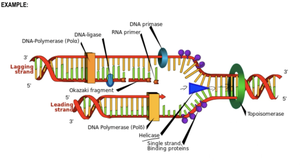
Leading strand synthesis needs one primer; lagging strand synthesis needs multiple primers for Okazaki fragments.
Key Experiments in DNA Structure and Replication
Meselson-Stahl Experiment: Demonstrated semiconservative replication in E. coli.
Hershey and Chase: Showed DNA is the genetic material using bacteriophages.
Watson, Crick, and Franklin: Determined the double helix structure of DNA.
Chargaff: Established base pairing rules (A=T, C=G).
Components and Enzymes of DNA Replication
Helicase: Unwinds the DNA double helix at the replication fork.
Single-stranded binding proteins (SSBs): Stabilize unwound DNA.
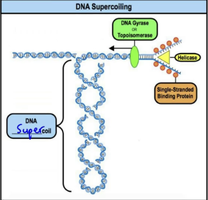
Topoisomerase (DNA gyrase): Relieves supercoiling ahead of the fork.
Primase: Synthesizes RNA primers for DNA polymerase to extend.
DNA Polymerase III: Main enzyme for DNA synthesis in prokaryotes.
DNA Polymerase I: Replaces RNA primers with DNA.
DNA Ligase: Joins Okazaki fragments on the lagging strand.
Origin of Replication and Replication Forks
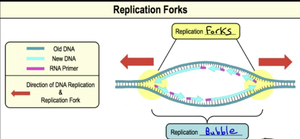
Replication begins at the origin of replication (ORI). Prokaryotes have one ORI; eukaryotes have multiple. Proteins bind to the ORI, forming a replication bubble with two replication forks where DNA is unwound and synthesis proceeds bidirectionally.
Unwinding the DNA: Topoisomerase, Helicase, and SSBs
Topoisomerase: Cuts and rejoins DNA to relieve supercoiling.
Helicase: Breaks hydrogen bonds to unwind DNA.
SSBs: Prevent reannealing and degradation of single-stranded DNA.
Leading and Lagging Strands
Leading strand: Synthesized continuously in the direction of the replication fork; requires one primer.
Lagging strand: Synthesized discontinuously in short Okazaki fragments, each requiring a primer; fragments joined by DNA ligase.
All DNA synthesis occurs in the 5’ to 3’ direction.
DNA Polymerase Requirements
Template: Parental DNA strand.
Primer: Short RNA segment synthesized by primase.
DNA polymerases also have proofreading (3’ to 5’ exonuclease) activity to correct errors, reducing mutation rates.
DNA Repair
Replication errors occur at a rate of 1 in 100,000 base pairs but are reduced to 1 in 10 billion by proofreading and repair enzymes. Malfunction in proofreading increases mutation rates and disease risk.
Telomeres and Telomerase
Telomeres: Non-coding, repetitive DNA at chromosome ends; shorten with each replication, linked to aging.
Telomerase: Enzyme that extends telomeres, active in germ and cancer cells, allowing continuous division.
Gene Expression: From Gene to Protein
Introduction to Transcription
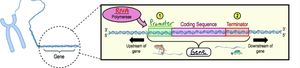
Transcription is the process of synthesizing RNA from a DNA template. A gene is a DNA sequence encoding a functional product (RNA or protein). Transcription is regulated by specific DNA sequences:
Promoter: Where RNA polymerase binds to initiate transcription.
Terminator: Where transcription ends.
Upstream: DNA sequence before the gene (opposite direction of transcription).
Downstream: DNA sequence after the gene (same direction as transcription).
Overview of Transcription
DNA has two strands: coding strand (same sequence as RNA, except T→U) and template strand (used for RNA synthesis).
RNA is synthesized 5’ to 3’ by pairing RNA nucleotides with the DNA template.
Steps of Transcription
Initiation: RNA polymerase binds to the promoter and unwinds DNA. In eukaryotes, transcription factors are required.
Elongation: RNA polymerase synthesizes RNA by adding nucleotides complementary to the DNA template.
Termination: Transcription ends at the terminator sequence. In eukaryotes, the RNA transcript undergoes processing before translation.
Transcription in Prokaryotes vs. Eukaryotes
Prokaryotes: One RNA polymerase, uses sigma factor for promoter recognition, can produce polycistronic mRNA (multiple genes per RNA).
Eukaryotes: Multiple RNA polymerases (Pol I, II, III), require general transcription factors, transcripts undergo extensive processing (capping, splicing, polyadenylation).
Key Enzyme Activities
Both RNA and DNA polymerases catalyze phosphodiester bond formation.
DNA polymerase has proofreading (3’ to 5’ exonuclease) activity; RNA polymerase does not.
Summary Table: DNA vs. RNA
Feature | DNA | RNA |
|---|---|---|
Sugar | Deoxyribose | Ribose |
Bases | A, T, C, G | A, U, C, G |
Strandedness | Double-stranded | Single-stranded |
Function | Genetic storage | Information transfer, catalysis |
Additional info: This guide integrates foundational concepts from classical to molecular genetics, emphasizing the structure, function, and regulation of genetic material.
