 Indietro
Genetics Exam Study Guide: Step-by-Step Guidance
Guida di studio - Note intelligenti
 Appunti personalizzati basati sui tuoi materiali, ampliati con definizioni chiave, esempi e contesto.
Q1. What is a gene? You may give the molecular or classical definition.
Background
Topic: Gene Definition
This question tests your understanding of what constitutes a gene, both from a classical genetics perspective and a molecular biology perspective.
Key Terms:
Gene: A unit of heredity; a segment of DNA that encodes a functional product (usually a protein or RNA).
Molecular definition: Focuses on DNA sequence and function.
Classical definition: Focuses on inheritance and phenotype.
Step-by-Step Guidance
Recall that genes are segments of DNA located on chromosomes.
Think about how genes are defined in classical genetics (as units of inheritance that determine traits).
Consider the molecular definition: genes are DNA sequences that code for proteins or functional RNAs.
Try to summarize both definitions in your own words, focusing on inheritance and molecular function.
Try solving on your own before revealing the answer!
Final Answer:
A gene is a segment of DNA that encodes a functional product, typically a protein or RNA. In classical genetics, a gene is a unit of heredity responsible for a specific trait. In molecular terms, it is a sequence of nucleotides that directs the synthesis of a functional molecule.
Q2. Red-green colorblindness is an X-linked recessive trait in humans. A man and woman both have normal color vision, but the woman’s father was colorblind. What is the probability that their kids will be colorblind? Break your answer down by the sex of the child.
Background
Topic: X-linked Inheritance
This question tests your understanding of X-linked recessive inheritance and how it affects males and females differently.
Key Terms and Formulas:
X-linked recessive trait: Trait carried on the X chromosome, expressed in males with one copy and females with two copies.
Carrier female: Heterozygous for the trait (one normal, one mutant allele).
Probability calculations: Use Punnett squares to determine likelihood for each sex.
Step-by-Step Guidance
Identify the genotypes: The woman is a carrier (since her father was colorblind), and the man is normal.
Set up a Punnett square for the cross: Woman (XCXc) × Man (XCY).
Determine the possible genotypes for sons and daughters.
Calculate the probability for each child (male and female) to be colorblind based on their genotype.
Try solving on your own before revealing the answer!
Final Answer:
For sons: 50% chance of being colorblind. For daughters: 0% chance of being colorblind, but 50% chance of being a carrier. This is because sons inherit their X chromosome from their mother, and daughters inherit one X from each parent.
Q3. In rare cases, a human may be born with only one sex chromosome. When this occurs, it is always the X chromosome that is present (genotype X0). A) What is the sex of an X0 individual? B) Why are Y0 individuals never encountered?
Background
Topic: Sex Chromosome Aneuploidy
This question tests your understanding of sex chromosome composition and its effects on human development.
Key Terms:
X0 genotype: Only one X chromosome, no second sex chromosome.
Turner syndrome: Condition associated with X0 individuals.
Y chromosome: Contains SRY gene necessary for male development.
Step-by-Step Guidance
Recall that the presence of a Y chromosome determines male sex in humans.
Consider what happens when only an X chromosome is present (X0 genotype).
Think about why a Y0 genotype (only a Y chromosome) is not viable.
Summarize the sex and viability of X0 and Y0 individuals.
Try solving on your own before revealing the answer!
Final Answer:
A) X0 individuals are female (Turner syndrome). B) Y0 individuals are never encountered because the X chromosome is essential for survival; the Y chromosome alone cannot support development.
Q4. In cats, the gene KTR71 controls fur production. There are three alleles: KTR(+), KTR(hr), and KTR(re). KTR(+) is dominant and produces normal fur. KTR(hr) produces sphinx (bald) cats and is recessive to KTR(+) but dominant over KTR(re), which produces rex cats. Answer the following:
a. Can a mating between two sphinx cats produce a cat with normal fur?
b. A mating between two cats with normal fur produced five kittens with normal fur and two sphinx kittens. What genotypes are possible for the parents?
c. Can a mating between two sphinx cats produce rex kittens? If so, what genotypes must the parents have?
Background
Topic: Multiple Alleles and Dominance Hierarchy
This question tests your understanding of how multiple alleles interact and how dominance relationships affect phenotypes.
Key Terms:
Dominance hierarchy: KTR(+) > KTR(hr) > KTR(re)
Genotype: Combination of alleles an individual has.
Phenotype: Observable trait (fur type).
Step-by-Step Guidance
List possible genotypes for each phenotype: normal fur (KTR(+)), sphinx (KTR(hr)), rex (KTR(re)).
For part a, consider the genotypes of sphinx cats and whether they can produce normal fur offspring.
For part b, use the ratio of offspring to infer possible parental genotypes.
For part c, determine if sphinx cats can produce rex kittens and what genotypes would be required.
Try solving on your own before revealing the answer!
Final Answer:
a. No, two sphinx cats cannot produce a cat with normal fur because neither parent carries the dominant KTR(+) allele. b. Possible parental genotypes: KTR(+)KTR(hr) × KTR(+)KTR(hr) or KTR(+)KTR(hr) × KTR(+)KTR(re). c. Yes, two sphinx cats can produce rex kittens if both are KTR(hr)KTR(re).
Q5. In 4 o’clock flowers, the color is determined by gene R, which exhibits incomplete dominance. Homozygous plants have either red (R1) or white (R2) flowers, while heterozygous plants have pink flowers. If two pink-flowered plants are crossed to produce 100 offspring, how many of each phenotype would you predict?
Background
Topic: Incomplete Dominance
This question tests your understanding of incomplete dominance and how it affects phenotypic ratios in offspring.
Key Terms and Formula:
Incomplete dominance: Heterozygotes have an intermediate phenotype.
Punnett square: Tool for predicting offspring genotypes and phenotypes.
Step-by-Step Guidance
Set up the cross: R1R2 × R1R2 (both parents are pink).
Use a Punnett square to determine the genotypes of the offspring.
Identify the phenotypes associated with each genotype: R1R1 (red), R1R2 (pink), R2R2 (white).
Calculate the expected ratio and apply it to 100 offspring.
Try solving on your own before revealing the answer!
Final Answer:
Expected ratio: 1 red : 2 pink : 1 white. Out of 100 offspring: 25 red, 50 pink, 25 white.
Q6. What is a loss-of-function mutation? How does it relate to recessive alleles?
Background
Topic: Mutation Types and Allele Function
This question tests your understanding of mutation effects and their relationship to dominance/recessiveness.
Key Terms:
Loss-of-function mutation: Mutation that reduces or eliminates the function of a gene product.
Recessive allele: Allele whose effect is masked in the presence of a dominant allele.
Step-by-Step Guidance
Define what a loss-of-function mutation is.
Explain how such mutations typically result in recessive alleles.
Consider why the presence of a normal allele can mask the effect of a loss-of-function allele.
Try solving on your own before revealing the answer!
Final Answer:
A loss-of-function mutation reduces or eliminates the activity of a gene product. These mutations are usually recessive because a normal allele can compensate for the loss, masking the mutant phenotype.
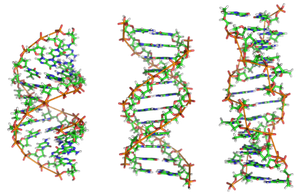
Q7. On the image below, label the positions of the phosphate-sugar backbone, the nitrogenous bases, and the major and minor grooves.
Background
Topic: DNA Structure
This question tests your ability to identify structural features of DNA, including the backbone, bases, and grooves.
Key Terms:
Phosphate-sugar backbone: The structural framework of DNA.
Nitrogenous bases: Adenine, thymine, cytosine, guanine.
Major and minor grooves: Spaces in the DNA helix where proteins can bind.
Step-by-Step Guidance
Examine the DNA structure and identify the repeating backbone (phosphate and sugar).
Locate the nitrogenous bases, which are attached to the backbone and pair in the center.
Identify the major and minor grooves, which are the larger and smaller spaces between the strands.
Try solving on your own before revealing the answer!
Final Answer:
The phosphate-sugar backbone is the outermost structure (red/orange), the nitrogenous bases are the horizontal rungs (green/blue), and the major and minor grooves are the wider and narrower spaces between the strands. The grooves are visible as alternating wide and narrow gaps along the helix.
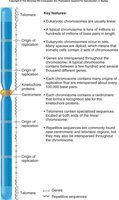
Q8. On the eukaryotic chromosome diagram below, indicate where you would find the following types of sequence: centromere, euchromatin, genes, constitutive heterochromatin, origins of replication, telomeres.
Background
Topic: Chromosome Structure
This question tests your understanding of the organization of a eukaryotic chromosome and the location of key sequence types.
Key Terms:
Centromere: Region where sister chromatids are joined.
Euchromatin: Less condensed, gene-rich regions.
Constitutive heterochromatin: Highly condensed, repetitive DNA.
Origins of replication: Sites where DNA replication begins.
Telomeres: Protective ends of chromosomes.
Step-by-Step Guidance
Identify the centromere, usually near the center or constricted region.
Locate telomeres at the ends of the chromosome.
Find euchromatin and genes in less condensed regions.
Constitutive heterochromatin is found near centromeres and telomeres.
Origins of replication are distributed throughout the chromosome.
Try solving on your own before revealing the answer!
Final Answer:
Centromere: central constriction; telomeres: ends; euchromatin and genes: dispersed throughout; constitutive heterochromatin: near centromere and telomeres; origins of replication: multiple sites along the chromosome.
